⚡ 800 VDC Data Center Power Architecture Market Forecast (2026–2034): Reaching USD 59.76 Billion at a 15.6% CAGR
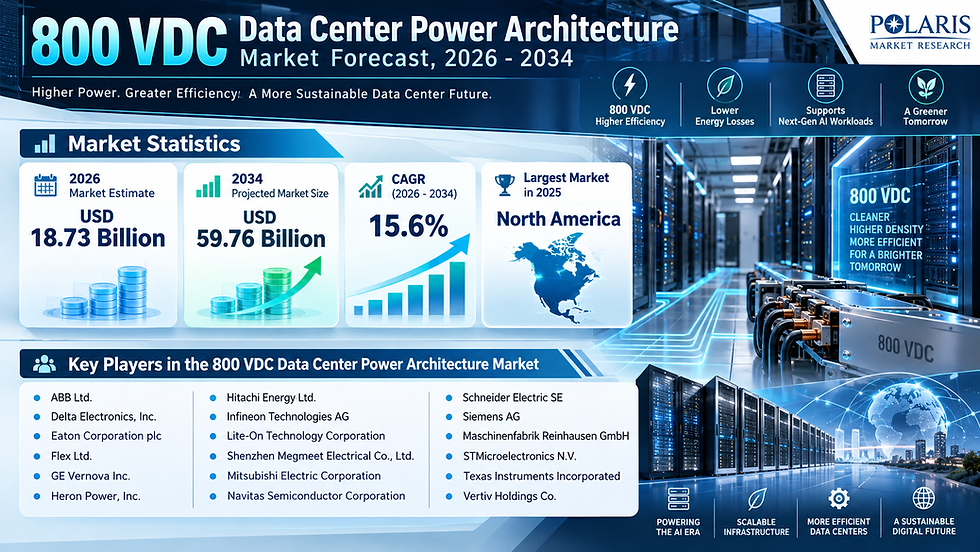
As artificial intelligence and high-performance computing push rack power requirements toward the megawatt scale, conventional 54 VDC and AC distribution architectures face physical and efficiency limits. The global 800 VDC data center power architecture market was valued at USD 16.24 billion in 2025 and is projected to expand to USD 18.73 billion in 2026, ultimately reaching USD 59.76 billion by 2034 at a robust CAGR of 15.6% during the forecast period from 2026 to 2034. Driven by the critical need to reduce power distribution losses, minimize copper usage, and support ultra-dense AI workloads, high-voltage direct current (HVDC) distribution is rapidly emerging as the gold standard for modern data center infrastructure.
📈 Market Overview
The 800 VDC data center power architecture market encompasses the specialized equipment responsible for transporting electricity from medium-voltage grid connections down to processors in hyperscale and AI data centers. This ecosystem includes switching, conversion, and protection components designed to adapt rack supplies from alternating current (AC) to 800 volts of direct current (VDC).
Operators are actively shifting away from legacy systems because racks drawing upwards of a megawatt cannot be efficiently served by standard low-voltage distribution. Prominent semiconductor and technology leaders most notably NVIDIA have spearheaded ecosystem alignment through initiatives like the Open Compute Project (OCP), setting the stage for widespread industry adoption.
🌐𝐁𝐫𝐨𝐰𝐬𝐞 𝐅𝐮𝐥𝐥 𝐈𝐧𝐬𝐢𝐠𝐡𝐭𝐬:
🚀 Key Market Growth Drivers
Growing Need for 800 VDC to Support High-Power AI Racks: The meteoric rise of generative AI and GPU-accelerated computing is driving individual rack power densities toward the 600 kW to 1 MW+ range. Powering such densities with traditional 54 VDC systems would require massive power shelves consuming up to 64U of rack space, leaving insufficient room for compute hardware. Platforms like NVIDIA’s Kyber and Rubin architectures are designed around 800 VDC to overcome these limitations.
Lower Power Losses and Reduced Copper Use: High-voltage transmission allows data centers to deliver the exact same amount of power using significantly smaller currents. This drastically minimizes electrical resistance losses and reduces conductor thickness and copper mass by up to 60% per megawatt, maximizing overall facility energy efficiency.
Faster, More Efficient Solid-State Transformers (SSTs): Traditional multi-stage power conversion setups introduce compounding energy penalties. The commercial maturation of solid-state transformers such as ABB’s Infinitus portfolio and Eaton’s MVSST 2.0 platform enables direct, highly efficient conversion from medium-voltage AC straight to an 800 VDC bus.
⚙️ Key Dynamics & Structural Shifts
Transitional vs. Native Architectural Pathways: To accommodate existing infrastructure, the market relies heavily on transitional sidecar power racks (such as those introduced by Vertiv and NVIDIA) that introduce 800 VDC capabilities to brownfield facilities without requiring complete teardowns. Concurrently, greenfield AI factories are beginning to design end-to-end native 800 VDC layouts for optimal long-term efficiency.
Regulatory Evolution and Standardization: While the technical and economic benefits of high-voltage direct current are undeniable, the absence of comprehensive legacy safety codes (such as NFPA and IEEE standards specifically tailored for 800 VDC arc-flash protection) has introduced cautious regulatory scrutiny. Collaborative efforts across the Open Compute Project are actively establishing uniform specifications for circuit breakers, switchgear, and busways to mitigate these hurdles.
Initial Capital Intensity: Upgrading existing facilities to support high-voltage direct current requires substantial initial investments in advanced power converters, specialized protective relays, and dedicated cabling, creating a measured pacing curve for enterprise and colocation retrofits.
⚠️ Market Challenges & Opportunities
Challenges
Standards Fragmentation: Minor disparities between competing proposals such as ±400 VDC systems promoted by certain hyperscalers versus NVIDIA's 800 VDC specifications can complicate equipment selection until global harmonization matures.
Safety & Certification Delays: The lack of fully established safety models and certification pathways for high-voltage DC components can temporarily extend procurement and deployment timelines.
High Upfront Costs: Deploying solid-state transformer infrastructure and specialized DC switchgear carries a premium over mature, conventional AC components.
Opportunities
Brownfield Retrofit Boom: The vast installed base of operating AC data centers represents an immediate, near-term revenue stream for sidecar power racks and hybrid architecture add-ons.
Next-Generation Component Integration: Rapid innovations in wide-bandgap power semiconductors specifically Silicon Carbide (SiC) and Gallium Nitride (GaN) supplied by industry leaders like Infineon, Texas Instruments, and Navitas unlock unprecedented power density and thermal efficiencies at the chip and board levels.
🌐𝐁𝐫𝐨𝐰𝐬𝐞 𝐅𝐮𝐥𝐥 𝐈𝐧𝐬𝐢𝐠𝐡𝐭𝐬:
🏢 Market Key Companies
The 800 VDC power ecosystem unites power systems giants, heavy electrical equipment manufacturers, and advanced semiconductor developers. Leading players include:
ABB Ltd.
Delta Electronics, Inc.
Eaton Corporation plc
Flex Ltd.
GE Vernova Inc.
Heron Power, Inc.
Hitachi Energy Ltd.
Infineon Technologies AG
Lite-On Technology Corporation
Shenzhen Megmeet Electrical Co., Ltd.
Mitsubishi Electric Corporation
Navitas Semiconductor Corporation
Schneider Electric SE
Siemens AG (in coordination with Maschinenfabrik Reinhausen GmbH)
STMicroelectronics N.V.
Texas Instruments Incorporated
Vertiv Holdings Co
📊 Market Segmentation
The market is comprehensively segmented by power architecture, deployment methodology, conversion systems, downstream conversion stages, and geography:
By Power Architecture: Spans Phase 1 (AC Rack Supply), Phase 2 (800 VDC Sidecar), Phase 3 (800 VDC Hybrid), and Phase 4 (Native 800 VDC). The Phase 1 – AC rack supply segment dominated with USD 16.24 billion in revenue in 2025 due to legacy installed bases, while advanced phases scale rapidly through the forecast window.
By Deployment Type: Categorized into Brownfield / Retrofit and Greenfield / New Build. The Retrofit segment captured 58.36% of the market share in 2025, driven by operators upgrading operational facilities.
By MV to 800 VDC Conversion System: Includes SST-Based Systems and MV Rectifier Systems. SST-based solutions are projected to reach USD 733.7 million by 2034, fueled by demand for minimized footprints and conversion loss reduction.
By Downstream Conversion Stage: Features categories such as 800 VDC to 50/54 V and 800 VDC to 12/6 V. The conversion from 800 VDC to 50/54 V segment is expected to be valued at USD 4.18 billion by 2034 to accommodate high-power density requirements in AI servers.
🌐 Market Trends & Regional Analysis
North America: Accounted for USD 6.22 billion in revenue in 2025, solidifying its position as the largest regional market. This dominance is heavily underpinned by massive capital expenditures from domestic hyperscalers and cloud innovators deploying next-generation AI infrastructure.
Asia Pacific: Projected to register a stellar CAGR of 16.7% over the forecast period. Rapid digital expansion across China, Japan, South Korea, Singapore, and India coupled with a robust regional power electronics manufacturing base is accelerating adoption.
Europe: Expected to witness a 15.0% CAGR, heavily driven by strict regional mandates for corporate energy efficiency, renewable power integration, and sustainable data center operations.
Middle East & Africa (MEA): Set to achieve a 16.4% CAGR, anchored by ambitious sovereign digital infrastructure builds in the UAE and Saudi Arabia that incorporate modern power architectures from inception.
Latin America: Anticipated to record a 14.1% CAGR, propelled by rising cloud service demands and greenfield data center developments across Brazil, Mexico, and Chile.
🔮 Future Outlook
The long-term trajectory of the 800 VDC data center power architecture market is exceptionally strong. As artificial intelligence workloads become more pervasive and energy constraints tighten, the transition from legacy AC and low-voltage DC setups to direct high-voltage distribution will accelerate. With major tier-one vendors commercializing integrated solid-state portfolios, advanced wide-bandgap semiconductors, and liquid-cooled busbar systems, the market is well on its path toward achieving its USD 59.76 billion valuation by 2034.


Comments