AI Accelerator Market Size, Forecast Values (USD 331.25 Billion by 2034) & CAGR (29.49%)
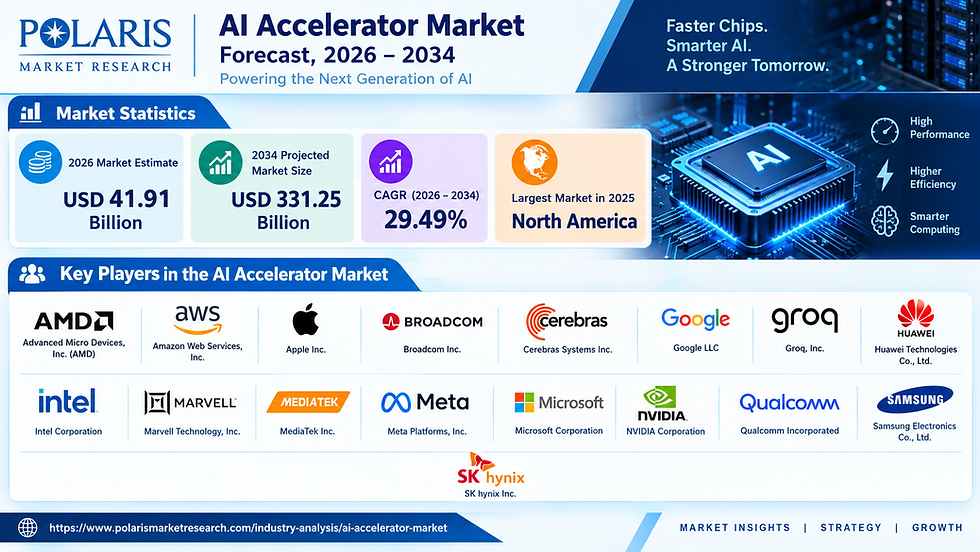
The rapid transformation of artificial intelligence from experimental models into core production infrastructure is reshaping the semiconductor landscape. The AI accelerator market size was valued at USD 32.40 billion in 2025 and is projected to expand significantly, reaching USD 41.91 billion in 2026 and scaling to USD 331.25 billion by 2034. Growing at a robust compound annual growth rate (CAGR) of 29.49% from 2026 to 2034, this industry sits at the absolute heart of modern digital infrastructure.
🌍 Market Overview
The AI accelerator market encompasses dedicated hardware architectures explicitly designed to accelerate machine learning operations through parallel throughput, tensor or matrix performance, memory bandwidth, data movement efficiency, and low-precision compute. Discrete graphics processing units (GPUs), tensor processing units (TPUs), application-specific integrated circuits (ASICs), field-programmable gate arrays (FPGAs), neural processing units (NPUs), accelerator cards, and cloud-exposed custom silicon all fall within this crucial technological scope.
Unlike general-purpose silicon, these specialized units are engineered specifically to overcome the computational bottlenecks of complex deep learning tasks. As enterprises successfully move AI workloads from experimentation into high-volume production, continuous serving, retrieval, reasoning, video processing, recommendations, and embedded inference create recurring compute requirements across cloud and edge device environments.
🌐𝐁𝐫𝐨𝐰𝐬𝐞 𝐅𝐮𝐥𝐥 𝐈𝐧𝐬𝐢𝐠𝐡𝐭𝐬:
🚀 Key Market Growth Drivers
Generative and Agentic AI Intensity: The rapid surge of large language models, multimodal generation, tool use, and agentic workflows requires massive parallel processing for training and continuous reasoning during inference.
Inference Specialization and Economics: Production workloads prioritize latency, throughput, and cost per token, prompting technology companies to adopt specialized inference hardware to optimize recurring operational expenses.
High Bandwidth Memory (HBM) Demand: Modern AI models require lightning-fast data movement for parameters, activations, and inference caches, making advanced memory stacks like HBM3e and HBM4 indispensable for maximizing throughput.
Edge Computing and On-Device Processing: Organizations increasingly demand local intelligence in automotive systems, robotics, industrial equipment, and connected cameras where connectivity is limited and latency must remain minimal.
Sovereign AI Initiatives: Governments worldwide are heavily investing in localized, controlled cloud environments and domestic semiconductor ecosystems to secure national AI capabilities.
📊 Key Market Dynamics
Intense Supplier Dependencies: High-performance accelerators rely heavily on advanced semiconductor manufacturing nodes, sophisticated packaging techniques, and secure supply chains for high bandwidth memory.
The Rise of Custom Silicon: Major hyperscalers including Google, Microsoft, Amazon, and Meta are designing proprietary custom ASICs (such as Google's TPU series and Microsoft's Maia accelerators) to optimize performance for specific cloud workloads.
Software Ecosystem Stickiness: Platform adoption is heavily influenced by developer tools, optimized compilers, open frameworks (such as PyTorch and ROCm), and mature software libraries like CUDA that reduce migration friction.
Interconnect and Scale-Out Complexity: As large-scale training and inference clusters expand to thousands of chips, efficient network topology, low latency, and advanced interconnects (like NVLink and Ethernet-based scale-out) become critical to maintaining high system utilization.
⚠️ Market Challenges and Opportunities
Challenges
Supply Chain Bottlenecks: Manufacturing complex accelerators requires tight coordination across advanced foundries, substrate suppliers, and packaging houses, creating deployment pacing constraints.
Power and Thermal Limits: High-performance data center clusters demand massive power delivery and sophisticated liquid cooling infrastructures, challenging existing facility designs.
High Capital Expenditure: Developing custom silicon or building hyperscale AI data centers involves steep initial investments and substantial engineering talent requirements.
Opportunities
Cost-Optimized Inference: Innovating around token generation economics opens massive new addressable markets as businesses evaluate production workloads by cost per token and power efficiency.
Open Software and Multi-Vendor Architectures: Lowering the technical barriers for alternative hardware platforms creates healthier competition and broadens procurement options for enterprise buyers.
Physical AI and Edge Deployment: Expanding intelligent machine applications in autonomous driving, industrial automation, and consumer electronics drives heavy demand for efficient edge NPUs and embedded modules.
🌐𝐁𝐫𝐨𝐰𝐬𝐞 𝐅𝐮𝐥𝐥 𝐈𝐧𝐬𝐢𝐠𝐡𝐭𝐬:
🏢 Market Key Companies
The global competitive landscape is concentrated among leading technology innovators equipped with advanced intellectual property, robust software relationships, and massive capital resources:
Advanced Micro Devices, Inc. (AMD)
Amazon Web Services, Inc. (AWS)
Apple Inc.
Broadcom Inc.
Cerebras Systems Inc.
Google LLC
Groq, Inc.
Huawei Technologies Co., Ltd.
Intel Corporation
Marvell Technology, Inc.
MediaTek Inc.
Meta Platforms, Inc.
Microsoft Corporation
NVIDIA Corporation
Qualcomm Incorporated
Samsung Electronics Co., Ltd.
SK hynix Inc.
🗂️ Market Segmentation
The global industry is thoroughly categorized across several distinct dimensions to evaluate specific ecosystem segments:
By Accelerator Architecture: Categorized into GPUs, Tensor Processing Units (TPUs) / Custom ASICs, FPGAs, Neural Processing Units (NPUs), and AI-Optimized CPUs / Hybrid Processors. GPUs accounted for 59.08% of the market share in 2025.
By Workload: Split between Training and Inference. While training held a major 57.12% share in 2025 due to foundational model development, the inference segment is growing rapidly at a 32.42% CAGR driven by continuous production serving.
By Deployment Environment: Divided into Data Center, Cloud, and Edge / Device environments, with centralized Data Center and Cloud installations capturing 74.12% of the 2025 market share.
By Sourcing Model: Differentiated by Merchant Silicon (holding 72.68% in 2025) and Hyperscaler / Custom Silicon (projected to record a strong 36.44% CAGR).
By Form Factor: Includes PCIe Add-in Cards, Server Modules, Integrated Accelerator Systems, Embedded SoCs, and Cloud Virtualized Capacity.
By End Use Industry: Spans Cloud & Hyperscale, IT & Telecom, BFSI, Automotive & Robotics, Healthcare & Life Sciences, Retail & Media, Manufacturing, and Government & Research.
📈 Market Trends
Shift Toward System-Level Design: Industry leaders are moving away from selling isolated chips, favoring integrated rack-scale systems that combine high-density compute, advanced networking, power delivery, and liquid cooling.
Adoption of Lower Numerical Precision: The widespread utilization of FP8, FP4, and INT8 formats is accelerating throughput and reducing memory overhead without sacrificing acceptable model accuracy.
Rapid Commercialization of HBM4: Mass production of next-generation memory stacks is beginning to address bandwidth bottlenecks for ultra-large language models.
🔮 Future Outlook
The long-term outlook for the AI accelerator market remains exceptionally strong. As artificial intelligence embeds itself deeply into enterprise workflows, consumer devices, and industrial machinery, incremental compute demand will be continuously driven by real-time user interactions and autonomous agentic workflows.
While supply chain dynamics, power density constraints, and infrastructure investments will continue to shape the pace of deployment, the ongoing convergence of customized silicon, advanced packaging, and optimized software ecosystems ensures that accelerated computing will remain the foundational pillar of the global digital economy through 2034.


Comments