AI in Material Discovery Market Forecast: Reaching USD 7,829.90 Million by 2034 at a 30.49% CAGR
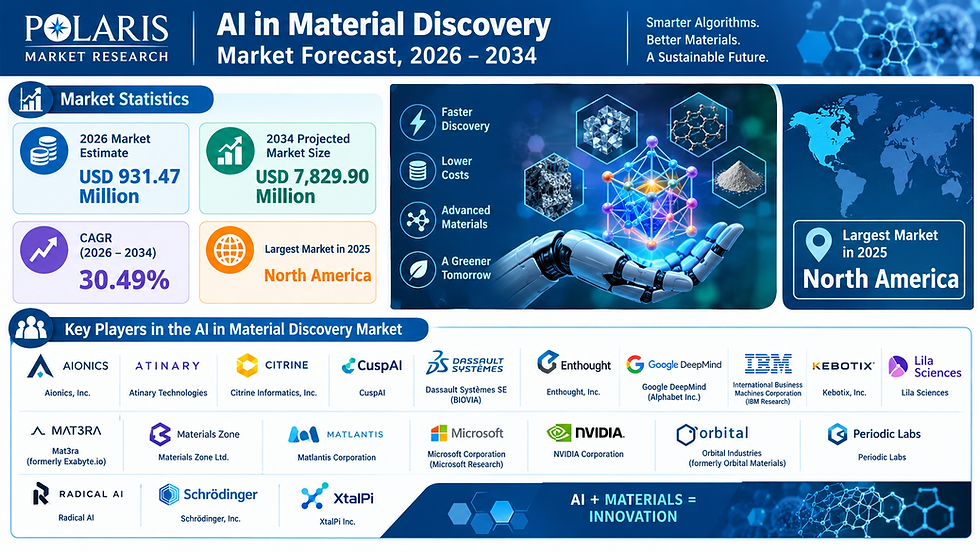
The convergence of artificial intelligence and materials science is no longer a distant theoretical concept; it is an active, high-growth commercial reality reshaping industrial R&D. Traditional trial-and-error laboratory experimentation is rapidly being superseded by advanced digital frameworks capable of predicting, generating, and validating novel chemical structures at unprecedented speeds. According to recent industry data, the AI in material discovery market size was valued at USD 714.57 million in 2025 and is estimated at USD 931.47 Million in 2026. Driven by the rapid proliferation of foundational models, graph-based learning architectures, and autonomous laboratory ecosystems, the market is projected to expand at an extraordinary CAGR of 30.49% from 2026 to 2034, scaling to a massive projected market size of USD 7,829.90 Million by 2034. For enterprise leaders, deep-tech investors, and R&D executives, understanding this paradigm shift is vital for maintaining a competitive edge across chemicals, electronics, energy, and advanced manufacturing sectors.
Comprehensive Market Overview
The AI in material discovery market encompasses sophisticated computational tools and artificial intelligence platforms explicitly engineered to design, generate, screen, and validate new materials. Unlike traditional material informatics platforms that focus primarily on retrospective data management and property prediction, core AI discovery engines utilize advanced machine learning paradigms to formulate brand-new chemical structures from scratch. These technologies include graph neural network discovery engines, diffusion models, generative architectures, foundation models, and closed-loop autonomous synthesis platforms that connect digital design directly with physical laboratory validation.
Geographically, the market exhibits a dynamic international footprint characterized by regional leadership and high-growth emerging zones. In 2025, North America dominated the AI in material discovery market with a 41.38% share, propelled by advanced computational infrastructure, heavy commercial investments, and pioneering research hubs established by major technology giants and premier universities. Meanwhile, the Asia Pacific region is anticipated to register the fastest growth at a staggering 38.74% CAGR during 2026–2034, supported by expanding artificial intelligence research, advanced manufacturing prowess, and national initiatives focused on semiconductor and green energy innovation.
European markets accounted for 22.44% of the global market in 2025, driven by strong commitments to sustainable materials, circular economy regulations, and advanced manufacturing collaborations. Latin America captured a 4.48% share in 2025, anchored by growing industrial applications across mining, energy, and chemicals. The Middle East & Africa region held a 4.08% share of the global market in 2025, supported by strategic national investments in scientific computing infrastructure, automated chemistry laboratories, and advanced materials research institutes.
🌐𝐁𝐫𝐨𝐰𝐬𝐞 𝐅𝐮𝐥𝐥 𝐈𝐧𝐬𝐢𝐠𝐡𝐭𝐬:
Key Market Growth Drivers
Foundation Models Driving De Novo Design: The evolution of deep-learning foundation models has revolutionized scientific exploration, shifting the industry from screening pre-existing candidates toward generative, de novo material design. Systems like Google DeepMind's GNoME and Microsoft Research's MatterGen empower researchers to predict and generate millions of novel, stable crystal structures instantly.
Surging Venture Capital and Strategic Investments: Commercial development is accelerating due to massive venture backing and corporate partnerships. Landmark funding rounds—such as CuspAI closing a $450 million Series B round at a $2.6 billion valuation—provide companies with the necessary capital to scale computational infrastructure, expand research teams, and deploy enterprise-grade platforms.
Accelerated High-Performance Computing (HPC): Breakthroughs in GPU-accelerated simulation platforms, such as NVIDIA's ALCHEMI microservices and Matlantis PFP machine learning potentials, enable researchers to evaluate tens of millions of candidate structures in months rather than decades.
Rise of Autonomous Synthesis Laboratories: The integration of robotic synthesis hardware with active-learning machine learning algorithms allows automated fabrication and physical testing, bridging the longstanding gap between digital simulation and laboratory reality.
Urgent Global Sustainability Mandates: Escalating global demands for zero-emission energy infrastructure, solid-state battery electrolytes, rare-earth-free magnets, and PFAS-free industrial coolants are forcing industries to adopt accelerated discovery workflows.
Key Market Dynamics
Paradigm Shift Toward Generative Workflows: The industry has transitioned from isolated database searching to multi-objective generative optimization, where AI models simultaneously maximize performance metrics while minimizing thermal instability and production costs.
Open-Science Collaboration and Shared Datasets: Foundational data repositories like The Materials Project provide robust empirical training grounds, democratizing machine learning access for academic institutions and industrial startups alike.
Physics-Informed Neural Networks (PINNs): Incorporating strict thermodynamic laws and quantum-mechanical principles directly into model loss functions ensures that generated molecular structures obey real-world physical constraints, minimizing false-positive outcomes.
Ecosystem Convergence: Software platform providers, specialized deep-tech startups, and semiconductor equipment manufacturers are actively forging collaborative foundry networks to commercialize AI-designed compounds rapidly.
Market Challenges and Opportunities
Challenges:
High Initial Infrastructure Deployments: Establishing high-performance computing clusters, acquiring specialized software licenses, and maintaining secure cloud architectures represent significant capital expenditures for mid-market enterprises.
Data Scarcity and Experimental Noise: Certain complex chemical spaces lack comprehensive empirical training datasets, which can occasionally lead to model generalization errors or kinetic roadblocks during synthesis.
The Sim-to-Real Gap: Translating computer-generated crystal structures into physical laboratory production frequently encounters unexpected thermodynamic or synthesis bottlenecks that require iterative refinement.
Opportunities:
Next-Generation Energy Storage & Batteries: Designing advanced solid electrolytes, high-capacity anodes, and safer cathodes to drastically improve electric vehicle (EV) driving range and grid-scale energy storage efficiency.
Green Hydrogen and Carbon Recycling Catalysis: Discovering cost-effective, platinum-free catalysts for water splitting and CO₂ conversion to support global decarbonization targets.
Semiconductor and Advanced Electronic Materials: Unlocking novel wide-bandgap semiconductors, thermal management fluids, and quantum materials to support next-generation high-density GPU computing.
🌐𝐁𝐫𝐨𝐰𝐬𝐞 𝐅𝐮𝐥𝐥 𝐈𝐧𝐬𝐢𝐠𝐡𝐭𝐬:
Market Key Companies
The competitive landscape of the generative materials design sector features an elite mix of technology conglomerates, specialized startups, and established scientific software providers, including:
Google DeepMind (Alphabet Inc.)
Microsoft Corporation (Microsoft Research)
NVIDIA Corporation
CuspAI
Lila Sciences
Schrödinger, Inc.
Dassault Systèmes SE (BIOVIA)
Orbital Industries
Citrine Informatics, Inc.
Periodic Labs
Radical AI
Market Segmentation Analysis
By Model Type: The market is segmented into graph neural network discovery engines, diffusion and generative models, and autonomous synthesis platforms. Graph neural network discovery engines held a dominant 42.36% market share in 2025, serving as the primary architecture for large-scale topological screening and crystal stability ranking. Meanwhile, diffusion and generative models are projected to register the fastest CAGR of 36.92% during 2026–2034, driven by their capacity to synthesize completely novel material structures on demand.
By Material Class: Segmentation includes inorganic crystals, molecules, catalysts, polymers, and other compounds. Inorganic crystals accounted for an impressive 28.64% share in 2025, anchored by heavy focus on stable crystalline lattices for electronics and energy infrastructure. Additionally, molecules and catalysts are projected to witness significant growth at a 33.76% CAGR from 2026 to 2034, fueled by chemical engineering and solar energy applications.
By Application: Core application verticals include energy storage and batteries, catalysis, semiconductors, and other industrial material development areas. Energy storage and batteries represented the major application category with a 32% market share in 2025, driven by intense global demand for advanced battery chemistries. Concurrently, catalysis applications are expected to grow at a significant rate of 32.84% CAGR during 2026–2034, propelled by requirements in solar cell manufacturing and CO₂ recycling.
Market Trends
Multimodal AI Integration: Modern discovery agents are increasingly combining natural language literature mining, crystal graph convolutions, and property-prediction transformers into unified workflows.
Closed-Loop Autonomous Discovery: Self-driving laboratories are becoming standard in advanced research centers, enabling robotic synthesis lines to operate under real-time AI feedback loops.
Agentic AI Platforms: Enterprise platforms are deploying autonomous multi-agent systems to manage atomistic simulations, coordinate knowledge engines, and streamline the path from hypothesis to physical testing.
Future Outlook
The future of materials science is inextricably bound to artificial intelligence. As accelerated computing hardware scales and autonomous laboratory validation becomes standard industrial practice, the traditional timeline required to discover, synthesize, and commercialize advanced materials will compress from decades to mere months. Surging toward a projected market valuation of USD 7,829.90 Million by 2034 at an impressive 30.49% CAGR, AI in material discovery stands as an indispensable foundational pillar for next-generation global technological progress, sustainable industrial manufacturing, and clean energy transition.

Comments