Comprehensive Analysis of the Global Lidocaine Hydrochloride Market: Strategic Industry Insights
The global healthcare ecosystem is shifting toward specialized patient care, advanced pain management, and specialized therapeutic formulations. At the forefront of this evolution is the global lidocaine hydrochloride market, a crucial segment of the localized anesthetics sector. Known for its quick onset of action and reliable efficacy, lidocaine hydrochloride remains an indispensable element across a variety of medical sectors, including dental health, surgical intervention, dermatology, and cardiology.
Understanding the structural shifts, technical progress, and geographic variances shaping this industry is essential for pharmaceutical executives, clinical practitioners, supply chain managers, and healthcare analysts. This article delivers an analysis derived directly from established intelligence reports, offering a comprehensive assessment of the market’s performance indicators, foundational dynamics, constraints, structural divisions, and regional trajectories through 2034.
Market Overview and Essential Performance Indicators
The worldwide lidocaine hydrochloride sector is entering a stage of stable economic expansion, supported by its foundational utility in local numbing and advanced medical formulations. Serving as a crucial localized anesthetic, the substance operates by blocking sodium channels along the nerve membrane, temporarily preventing the transmission of pain signals. This mechanism remains vital for both routine minor medical checks and complex outpatient surgical procedures.
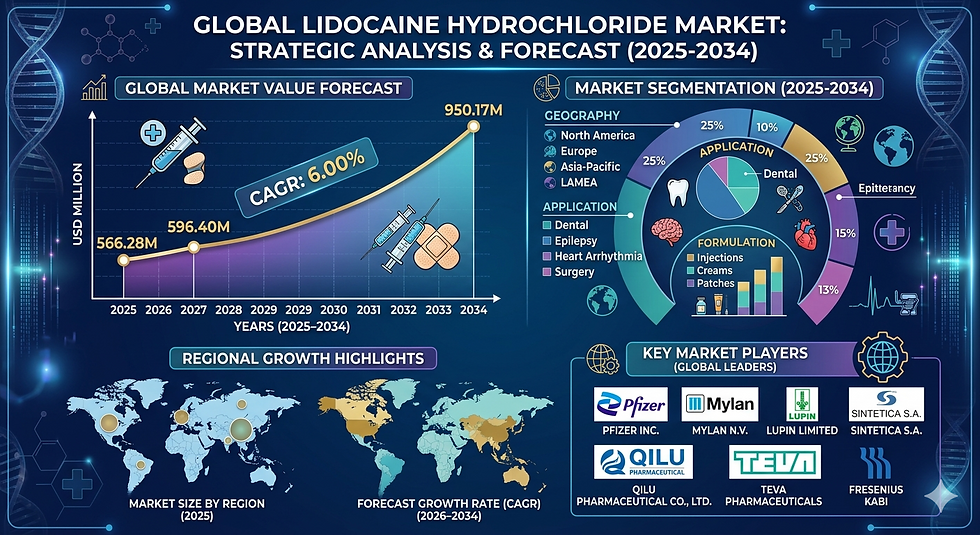
Data reveals that the global lidocaine hydrochloride market achieved a valuation of USD 566.28 million in the 2025 base year.Moving forward into the forecast window spanning from 2026 through 2034, the sector is projected to experience a compound annual growth rate (CAGR) of 6.00%.Benefiting from consistent clinical demand and developments in formulation technologies, the industry's total valuation is anticipated to reach USD 950.17 million by the conclusion of 2034.
Historically, the market has maintained a steady trajectory. Evaluating earlier data over the 2021 to 2024 period highlights an established base of adoption that has set the stage for upcoming expansions. For context regarding mid-term progress, the industry value is tracked at USD 596.40 million for the year 2026. This consistent performance underscores the drug’s primary role in addressing pain and regional discomfort across modern medical treatments.
Strategic Market Drivers
The steady expansion of the global lidocaine hydrochloride landscape is supported by shifts in demographic structures, evolving patient needs, and an increasing volume of clinical procedures worldwide. The primary growth forces propelling the market include:
Expanding Elderly Demographic: A key driver is the global increase in the geriatric population.Aging populations show a higher incidence of age-related conditions, degenerative musculoskeletal disorders, and conditions requiring surgical or pain management treatments.Lidocaine hydrochloride functions efficiently to address the expanding need for safe, reliable pain management options within this vulnerable age cohort.
Escalating Volume of Medical and Dental Procedures: The general growth in minor surgeries, preventative health treatments, and dental procedures acts as a direct driver for local anesthetics. Because regional numbing is standard for modern diagnostic interventions and therapeutic operations, the baseline volume of drug utilization continues to rise.
Surge in Aesthetic and Cosmetic Interventions: Growing consumer focus on dermatological wellness and aesthetic appearance has generated substantial demand for minimally invasive cosmetic treatments. Procedures like dermal fillers, laser therapies, tattoo removals, and minor skin operations rely heavily on pre-treatment numbing agents to maximize patient comfort and compliance.
Advancements in Topical Drug Delivery Systems: Ongoing innovation within pharmaceutical manufacturing has expanded the clinical utility of local anesthetics. The development of advanced, stable transdermal options—such as sophisticated patches, controlled-release creams, and structured gels—has improved the therapeutic value, safety profiles, and ease of use of lidocaine formulations.
Rising Prevalence of Chronic Pain and Skin Disorders: The growing long-term incidence of persistent pain conditions, alongside common dermatological issues like eczema, shingles, severe itching, minor burns, and insect bites, reinforces a large retail and clinical market for therapeutic formulations containing lidocaine hydrochloride.
𝐄𝐱𝐩𝐥𝐨𝐫𝐞 𝐓𝐡𝐞 𝐂𝐨𝐦𝐩𝐥𝐞𝐭𝐞 𝐂𝐨𝐦𝐩𝐫𝐞𝐡𝐞𝐧𝐬𝐢𝐯𝐞 𝐑𝐞𝐩𝐨𝐫𝐭 𝐇𝐞𝐫𝐞:
Market Dynamics
The structural interactions within the market depend on balancing manufacturing innovations against strict regulatory criteria. Industry dynamics show how provider preferences and systemic healthcare adjustments alter product use.
Patient Preference for Non-Invasive Formulations: A major dynamic involves shifting consumer preferences toward topical applications, especially among individuals dealing with medical anxiety or needle sensitivity.The comfort, ease of use, and self-administration features of cream or patch formulations support their increasing use over injectable alternatives where appropriate.
Shifting Distribution Networks toward Accessible Care: The growing role of regional retail spaces and outpatient delivery networks marks an important evolution in the market. While complex interventions remain centered in hospital networks, the availability of localized pain products over-the-counter and via community pharmacies has shifted standard purchasing behaviors.
Technological Modernization among Global Producers: The competitive field features continuous structural and technological updates. Global manufacturers are actively upgrading their production systems, purification steps, and compounding methodologies to maintain high product integrity, manufacturing safety, and long-term supply stability.
Market Challenges and Strategic Opportunities
To optimize operational strategies, market participants must manage structural barriers while positioning themselves to capture emerging high-value growth channels.
Structural Challenges
Rigorous Regulatory Frameworks and Approvals: Because lidocaine hydrochloride is a potent pharmaceutical agent capable of inducing system-wide effects if misused, international regulatory bodies enforce strict approval criteria, continuous manufacturing audits, and detailed quality benchmarks that can delay time-to-market.
Systemic Pricing Pressures: The presence of multiple international and regional manufacturing entities fosters intense competition. This fragmentation places notable downward pricing pressure on standard formulations, squeezing profit margins for baseline generic commodities.
Managing Toxicity and Adverse Reaction Risks: Ensuring overall patient safety amid potential risks of systemic toxicity, localized allergic reactions, or incorrect dosing remains a critical requirement. Companies must continuous emphasize clear education, targeted labeling, and precise formulation design to protect consumer trust.
Commercial Opportunities
Formulation Innovation for Targeted Delivery: Creating optimized drug delivery methods, such as specialized hydrogel patches and time-released topical matrices, offers clear pathways for premium market positioning.
Expanding Care in Alternative Settings: The clear shift toward outpatient medical clinics, independent surgical centers, and home-based pain care creates a commercial opening to supply customized, easy-to-use anesthetic configurations tailored for non-hospital environments.
Addressing Unmet Needs in Developing Medical Environments: Increasing focus on healthcare access across emerging economies provides a large landscape for expanding baseline anesthetic distribution, driven by modernizing infrastructure and rising regional healthcare spending.
Comprehensive Market Segmentation
The lidocaine hydrochloride landscape is classified across specialized segments reflecting dosage formats, clinical applications, distribution channels, and regional settings.
By Dosage Configuration
Injections: This configuration represents a fundamental clinical segment. Injectable formats are vital for local infiltration, nerve block procedures, spinal anesthesia, and specific acute cardiac interventions where rapid, direct block of sodium channels is necessary.
Creams: This segment is projected to achieve strong growth during the forecast window.Functioning as an efficient analgesic that blocks regional nerve signals, creams are highly favored for treating minor cuts, skin abrasions, eczema, insect bites, and localized anal discomfort.Their ability to alleviate anxiety relative to needle injections supports their growth.
Patches: Utilizing advanced transdermal delivery innovations, patches provide controlled, prolonged relief for localized neuropathic pain, such as post-herpetic neuralgia, making them highly popular in chronic pain management.
Others: This category encompasses alternative formulations, including specialized medical jellies, topical sprays, and liquid solutions tailored for specific mucosal or diagnostic applications.
By Clinical Application
Dental Procedures: In 2025, the dental procedures segment held a dominant position in the global market.Lidocaine hydrochloride serves as the standard numbing selection to desensitize oral tissues prior to extractions, root canals, and structural repairs.The rising frequency of periodontal conditions and expanding access to dental services ensure this segment remains a key source of revenue.
Epilepsy: In specialized clinical contexts, lidocaine formulations find targeted applications in managing acute, non-responsive convulsive states due to their active neurological pathways.
Heart Arrhythmia: Because it acts efficiently as a Class Ib antiarrhythmic agent, the drug is used intravenously in critical care settings to stabilize ventricular arrhythmias and regulate irregular heart rhythms.
Others: This covers varied applications, from general minor outpatient surgeries and endoscopic examinations to OTC topical relief for everyday skin irritations.
By Distribution Channel
Retail Pharmacies: This segment secured a dominant position in the distribution landscape in 2025 and is projected to see the highest growth rate during the forecast timeframe.Growth is powered by the increasing volume of community-based dental and aesthetic procedures, along with rising consumer demand for accessible, over-the-counter pain solutions.
Hospitals: Hospitals represent an enduring institutional end-user, accounting for bulk consumption of injectable local anesthetics used across acute surgical settings, trauma centers, and emergency medicine departments.
Online Pharmacies: Reflecting broader changes in healthcare e-commerce, the online pharmacy segment is expanding rapidly, supported by the convenience of home delivery and the growing digitalization of prescription fulfillment.
Country-Wise and Regional Analysis
Evaluating the market across specific geographical regions highlights the varied economic and infrastructure conditions shaping industry expansion.
Global Lidocaine Hydrochloride Market (2025–2034)
 ├── North America (Largest Market Share in 2025)
 │ ├── United States (Advanced healthcare, cosmetic procedures)
 │ └── Canada (Favorable regulatory support, aging population)
 ├── Europe
 │ └── Focus on pain management & preventative clinical standards
 └── Asia-Pacific (Rapid Growth Region)
 ├── China (Expanding manufacturing & clinical infrastructure)
 └── India (Rising cardiovascular, dental, & therapeutic demands)
North America
North America dominated the global market in 2025, securing the largest revenue share, and is poised to sustain its leading position through 2034.
United States: The U.S. market is highly robust, driven by a dense network of major pharmaceutical companies, advanced healthcare facilities, and a dynamic startup ecosystem introducing novel topical formulations. The high volume of elective cosmetic treatments, well-funded dental healthcare systems, and an aging population requiring consistent pain management reinforce its top market position.
Canada: Growth in Canada is supported by strict, clear regulatory systems, a growing geriatric demographic, and strong institutional adoption of advanced localized pain management protocols within its universal healthcare system.
Europe
The European landscape shows steady, structured growth across major national economies.
Germany, United Kingdom, and France: These countries are characterized by high healthcare standards, well-organized clinical trial systems, and strong regulatory monitoring under the European Medicines Agency (EMA). Market expansion here is driven by integrating advanced patch and gel applications into standard post-operative care and managing a high incidence of chronic age-related disorders.
Asia-Pacific
The Asia-Pacific region is recognized as the fastest-growing geographical market, fueled by accelerating economic development and massive population bases.
China: China is rapidly expanding its market footprint due to its large-scale pharmaceutical manufacturing capabilities and a massive aging demographic. The rising prevalence of conditions like cardiac arrhythmias, cancer-related pain, and dental health challenges, combined with expanding healthcare coverage, drives significant volume consumption.
India: India represents an expanding manufacturing and consumption market. Growth is propelled by escalating investments in clinical infrastructure, a rising volume of surgical procedures, and increasing public awareness regarding advanced pain care options.
Future Outlook
The long-term trajectory of the global lidocaine hydrochloride market points toward steady, sustained development through 2034. As healthcare delivery models focus more on patient comfort and cost-efficient outpatient procedures, localized anesthetics will remain a key component of modern clinical care. The market's evolution will likely center on refining transdermal delivery systems to extend the duration of pain relief while minimizing systemic absorption risks.
Furthermore, as emerging economies in Asia-Pacific and Latin America expand their clinical infrastructure, global consumption patterns are expected to become more balanced. Manufacturers who balance price efficiency with advanced formulation standards will be well-positioned to lead the market, which is projected to approach USD 950.17 million by 2034.
Competitive Field and Key Market Companies
The global lidocaine hydrochloride market features a fragmented competitive landscape characterized by intense rivalry among established multi-national corporations and specialized regional producers. Companies compete based on manufacturing capacity, adherence to global regulatory standards, formulation safety, and distribution network reach.
Major market entities profiled within the industry intelligence include:
Pfizer Inc.
Mylan N.V.
Lupin Limited
Sintetica S.A.
Qilu Pharmaceutical Co., Ltd.
These key market companies frequently utilize targeted strategies, including technology upgrades, regulatory compliance enhancements, portfolio diversification, and strategic supply partnerships to secure a competitive advantage and expand their global market share.


Comments