Fall Protection Equipment Market Growth Driven by Rising Workplace Safety Awareness
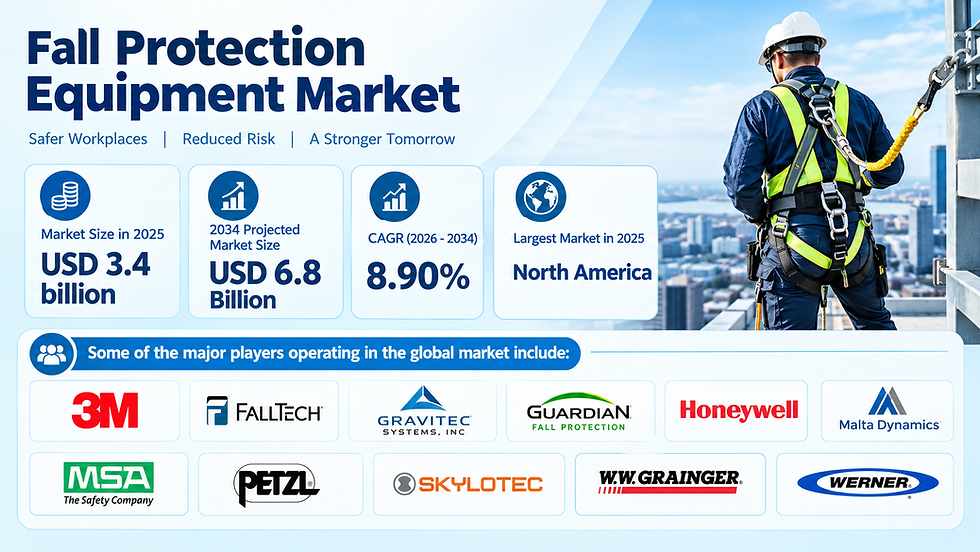
The global Fall Protection Equipment Market is growing as businesses place greater importance on worker safety and accident prevention. According to Polaris Market Research, the market was valued at USD 3.4 billion in 2025 and is projected to reach USD 6.8 billion by 2034, registering a compound annual growth rate (CAGR) of 8.90% from 2026 to 2034. Increasing construction activities, stricter workplace safety regulations, and growing investment in industrial infrastructure are supporting this growth.
Understanding Fall Protection Equipment
Fall protection equipment includes safety products designed to prevent falls or reduce the risk of serious injuries when workers perform tasks at heights. Common products include full-body harnesses, safety belts, lanyards, lifelines, anchor points, safety nets, and rescue kits.
These products are widely used in construction, oil and gas, mining, telecommunications, transportation, and energy and utilities. By providing suitable protection, businesses can improve workplace safety and help workers perform tasks with greater confidence.
Key Factors Driving Market Growth
The expansion of the construction industry is a major factor driving demand for fall protection equipment. Workers involved in building construction, roofing, bridge development, and infrastructure maintenance often face risks when working at elevated locations. As construction projects increase, employers need dependable safety equipment to protect workers and meet applicable safety requirements.
Strict workplace safety regulations are another important growth driver. Companies are increasingly investing in protective equipment, employee training, and risk management programs to reduce workplace accidents and improve compliance.
The expansion of renewable energy and telecommunications infrastructure is also creating opportunities. Wind turbine maintenance, power line repairs, and tower installation frequently require workers to operate at significant heights, increasing the need for reliable fall protection solutions.
Emerging Trends and Technological Advancements
Technology is changing how companies approach workplace safety. Manufacturers are developing lightweight harnesses, improved shock-absorbing materials, and self-retracting lifelines that support worker mobility and comfort.
Smart safety equipment is another emerging trend. Connected wearable devices and sensor-enabled systems can help monitor worker movement and identify potentially unsafe conditions. When integrated with appropriate monitoring platforms, these technologies can provide alerts and support more proactive safety management.
Artificial intelligence and predictive analytics are also creating new possibilities. Businesses can use safety data to identify recurring hazards, improve training, and strengthen workplace risk assessments. These technologies complement established safety procedures rather than replacing proper equipment, training, and supervision.
Regional Market Opportunities
North America held the largest regional revenue share of 38.7% in 2025, supported by workplace safety requirements and demand across construction and industrial sectors. Meanwhile, Asia Pacific is expected to register the fastest growth, with a projected CAGR of 9.8% during the forecast period. Industrial expansion, infrastructure investment, and increasing attention to workplace safety are supporting regional demand.
Browse In-depth Market Research Report:
Key Players in the Fall Protection Equipment Market
Major companies operating in the market include:
3M
FallTech
Gravitec Systems, Inc.
Guardian Fall Protection
Honeywell International
Malta Dynamics
MSA Safety
Petzl
SKYLOTEC
W.W. Grainger, Inc.
WernerCo.
These companies compete through product innovation, improved equipment design, strategic partnerships, and geographic expansion. Their offerings serve customers across construction, manufacturing, energy, and other industries where working at heights presents safety risks.
Challenges and Future Outlook
Despite its positive outlook, the market faces challenges such as the availability of low-quality products, price competition, and limited awareness of proper equipment selection in some markets. Incorrect use, inadequate training, and poor equipment maintenance can also reduce the effectiveness of fall protection systems.
Looking ahead, continued investment in infrastructure, stronger safety practices, and advances in connected protective equipment are expected to create further opportunities. Manufacturers that prioritize product reliability, comfort, compliance, and innovation will be well positioned to meet changing customer needs.
Overall, fall protection equipment will remain essential to workplace safety. As businesses increasingly recognize the importance of protecting employees and reducing occupational risks, demand for dependable fall protection solutions is expected to continue growing.
Conclucion
The Fall Protection Equipment Market is expected to experience steady growth as workplace safety becomes a greater priority across construction, manufacturing, energy, and other industries. Increasing infrastructure development, stricter safety requirements, and advancements in smart protective equipment are creating new opportunities for market participants. As businesses continue to invest in reliable safety solutions and employee protection, manufacturers focusing on product quality, comfort, and technological innovation are likely to strengthen their market position in the coming years.
More Trending Latest Reports By Polaris Market Research:

Comments