Global Ear, Nose, and Throat (ENT) Devices Market Size to Hit USD 46.74 Billion by 2034, Expanding at a 5.56% CAGR 📈🩺
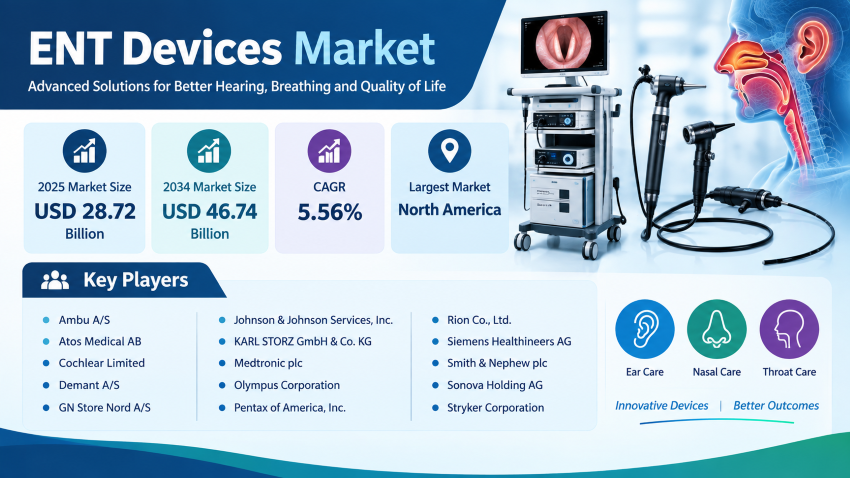
The global ear, nose, and throat (ENT) devices market stands at a critical juncture of medical innovation and clinical evolution. As healthcare systems worldwide prioritize precise diagnosis and patient-centric interventions, the demand for advanced otolaryngology devices has surged significantly. Industry intelligence indicates that the global ENT devices market size was valued at USD 28.72 billion in 2025 and is projected to expand to USD 30.28 billion in 2026, ultimately scaling up to USD 46.74 billion by 2034, growing at a robust CAGR of 5.56% over the forecast period from 2026 to 2034.
Professionals, medical technology leaders, and healthcare investors tracking this space must evaluate the underlying drivers, transformative technologies, and structural shifts shaping the future of global ear, nose, and throat care.
Market Overview and Executive Summary
The ENT medical devices market encompasses a comprehensive range of diagnostic, surgical, and therapeutic tools utilized by physicians to manage and treat conditions affecting the ears, nose, throat, and upper respiratory system. From managing chronic sinusitis and hearing impairments to treating sleep apnea and voice disorders, these specialized instruments play an indispensable role in modern clinical practice.
In 2025, North America anchored the global landscape, holding the largest ENT devices market share of 37.80%, underpinned by sophisticated healthcare infrastructure and rapid clinical adoption of novel technologies. Meanwhile, the Asia Pacific region is anticipated to showcase the fastest growth rate, expanding at a CAGR of 6.24% throughout the forecast period, powered by increasing healthcare expenditure, expanding medical access, and heightened patient awareness.
🌐𝐁𝐫𝐨𝐰𝐬𝐞 𝐅𝐮𝐥𝐥 𝐈𝐧𝐬𝐢𝐠𝐡𝐭𝐬:
Key Market Growth Drivers
Market expansion is propelled by several compounding macro-economic and clinical tailwinds. The primary growth catalysts include:
Rising Prevalence of ENT Disorders: A continuous escalation in cases of chronic sinusitis, persistent ear infections, hearing impairments, and vocal cord pathologies driven by environmental pollution, changing lifestyles, and rising allergy rates. According to a January 2025 CDC report, approximately 2 to 3 out of every 1,000 children in the U.S. are born with detectable hearing loss, with over 98% of newborns receiving critical hearing screenings and more than 6,000 infants identified with hearing loss.
Expanding Geriatric Demographic: The steady increase in the global aging population represents a major catalyst, as elderly cohorts experience higher rates of age-related hearing loss and chronic upper respiratory conditions that necessitate long-term therapeutic interventions.
Advancements in Minimally Invasive and Digital Technologies: Continuous technical upgrades, such as image-guided ENT surgery systems, video endoscopes, and robotic-assisted interventions, offer superior precision, reduced tissue damage, and shorter patient recovery times compared to traditional treatment methods.
Government Investments and Healthcare Funding: Heightened financial allocations by governing bodies to modernize hospital infrastructure. For instance, an April 2025 report by the IBEF noted that the Indian Union Budget for 2025–26 allotted USD 11.50 billion to the healthcare sector, reflecting a 9.78% increase from previous allocations and facilitating broader adoption of advanced diagnostic equipment.
Key Dynamics and Industry Shifts
The structural evolution of the otolaryngology devices market is governed by distinct operational and technological forces. Ongoing capital investments in the modernization of healthcare facilities and the integration of diagnostic services into primary care systems are streamlining patient pathways.
Furthermore, the integration of Artificial Intelligence (AI) is redefining clinical standards. AI-powered algorithms enhance diagnostic accuracy by analyzing complex medical imaging and test results for sinus and hearing ailments. Technologies like GN’s introduction in February 2025 of ReSound Vivia the world's smallest AI-powered hearing aid leveraging Intelligent Focus and a deep neural network (DNN) chip trained on 13.5 million speech samples alongside the Bluetooth LE Audio-supported ReSound Savi exemplify how personalized, adaptive hearing solutions are transforming patient care. AI systems also enable continuous patient monitoring, triggering automated clinical alerts when therapy adjustments are required.
Market Challenges and Restraints
Despite favorable growth trajectories, industry stakeholders navigate several persistent headwinds that constrain rapid market penetration:
High Cost of Advanced Devices: The substantial upfront expenditure associated with cutting-edge robotic tools, advanced navigation systems, and AI-enabled hearing instruments creates affordability barriers for smaller ambulatory surgical centers and clinics in developing economies.
Regulatory and Reimbursement Complexities: Stringent regulatory approval pathways for novel medical devices and varying reimbursement frameworks across global territories can delay commercialization timelines for emerging manufacturers.
Awareness Gaps in Underserved Regions: A lack of specialized healthcare professionals and insufficient patient awareness regarding early diagnosis in remote or rural geographic locations restricts the universal adoption of advanced ENT technologies.
Market Opportunities and Commercial Growth Vectors
Emerging market frontiers present significant avenues for expansion among device developers and clinical providers:
Adoption of Outpatient and Day-Care Surgeries: The ongoing medical shift toward outpatient procedures increases the demand for portable, highly efficient, and minimally invasive ENT surgical tools.
Penetration in Emerging Economies: Rapid healthcare infrastructure development across the Asia Pacific and Latin America offers untapped potential to introduce cost-effective diagnostic and therapeutic ENT equipment.
Customized and Smart Wearables: Developing interconnected, discreet, and patient-tailored hearing devices that support wireless connectivity creates immense value for tech-savvy consumer segments across all age brackets.
Market Segmentation Analysis
The global ENT devices market is structured across multiple product categories, end-users, and functional applications:
By Product Category: The market bifurcates into diagnostic devices and surgical devices. In 2025, the endoscopes segment captured a dominant 62.0% share of diagnostic applications due to its unmatched efficacy in visualizing delicate nasal and laryngeal pathways. Meanwhile, the hearing aids segment spearheaded the broader market in 2025 with a 30.50% share, driven by widespread adoption across diverse age demographics addressing hearing impairments.
By Sub-Segments: Key product classes include hearing aids, hearing implants, endoscopes, powered surgical tools, image-guided navigation systems, and specialized ENT consumables.
By End User: Hospitals, specialty clinics, ambulatory surgical centers, and home-care settings represent primary institutional consumers driving continuous bulk procurement of otolaryngology equipment.
🌐𝐁𝐫𝐨𝐰𝐬𝐞 𝐅𝐮𝐥𝐥 𝐈𝐧𝐬𝐢𝐠𝐡𝐭𝐬:
Leading ENT Device Companies and Key Manufacturers
The competitive landscape of the global ENT medical devices market features intensive rivalry among established multinational medtech corporations focusing on strategic product launches, regulatory approvals, and technological acquisitions. Prominent market participants steering industry standards include:
Medtronic plc
Stryker Corporation
Smith & Nephew plc
Olympus Corporation
GN Store Nord A/S (GN Hearing)
Sonova Holding AG
Demant A/S
William Demant Holding A/S
Karl Storz SE & Co. KG
Acclarent, Inc. (Johnson & Johnson)
Market Trends
Integration of Wireless and Bluetooth Connectivity: Modern hearing solutions and diagnostic aids increasingly incorporate Bluetooth LE Audio and Auracast capabilities to sync seamlessly with smartphones and communication networks.
Rise of Robotic-Assisted Otolaryngology: Increased deployment of micro-robotic arms and navigation systems during complex sinus and skull base procedures to ensure maximum safety.
Focus on Ergonomics and Patient Comfort: Manufacturers are prioritizing smaller, lightweight, and aesthetically discreet designs to improve user compliance and reduce social stigma associated with wearing assistive devices.
Future Outlook
The trajectory of the global ear, nose, and throat (ENT) devices market through 2034 remains exceptionally promising. Supported by a projected market valuation of USD 46.74 billion by the end of the forecast period, the industry will continue to benefit from convergence between artificial intelligence, precision surgery, and expanded healthcare access. Companies that successfully balance technological innovation with cost-optimized manufacturing will lead the next wave of commercial expansion in global otolaryngology.


Comments