Global Nuclear Fusion Market Forecast: Reaching USD 49.73 Billion at a 13.49% CAGR
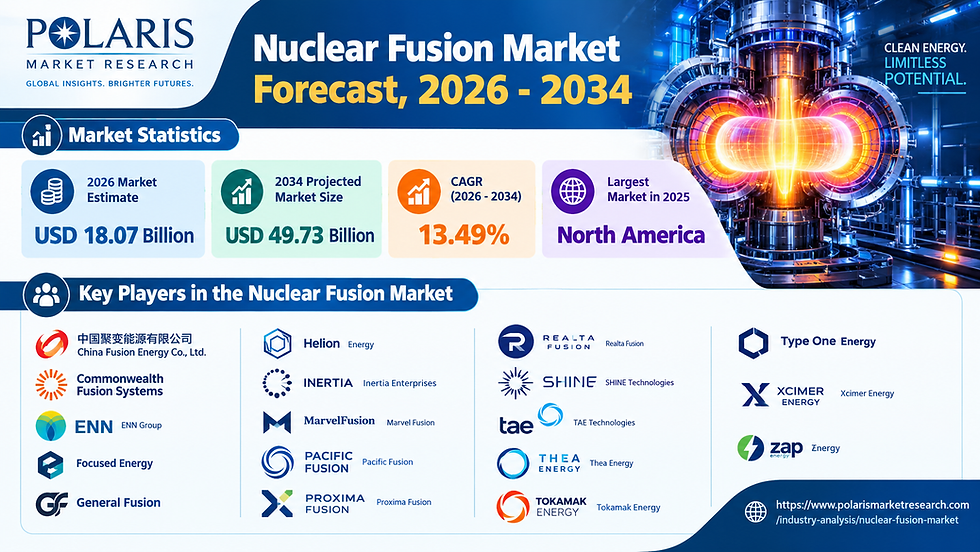
The nuclear fusion market represents a transformative shift in the global energy landscape, transitioning from experimental research toward commercial viability. According to recent industry analysis, the market size was valued at USD 15.94 Billion in 2025 and is projected to surge to USD 49.73 Billion by 2034, expanding at a robust Compound Annual Growth Rate (CAGR) of 13.49% from 2026 to 2034. This unprecedented trajectory is heavily propelled by private capital influx, pilot-plant development, and significant breakthroughs in enabling technologies.
Market Overview
The nuclear fusion market encompasses the technologies, equipment, engineering, fuels, materials, research programs, demonstration systems, and services required to achieve controlled fusion and convert energy into useful power. Encompassing magnetic, inertial, and alternative confinement approaches along with advanced superconducting systems, the industry is witnessing rapid structural development.
2026 Market Estimate: USD 18.07 Billion
2034 Projected Market Size: USD 49.73 Billion
Compound Annual Growth Rate (CAGR): 13.49% (2026–2034)
Largest Regional Market (2025): North America (accounting for 36.82% of the global market)
🌐𝐁𝐫𝐨𝐰𝐬𝐞 𝐅𝐮𝐥𝐥 𝐈𝐧𝐬𝐢𝐠𝐡𝐭𝐬:
Key Market Growth Drivers
Growing Commercialization Focus: The concerted move from laboratory experiments toward pilot-plant design is surging demand across the fusion value chain. Government initiatives like the DOE's finalized Fusion Science and Technology Roadmap target pilot plants and commercial power in the mid-2030s.
Surging Private Fusion Investment: Private capital is supercharging the ecosystem, with fusion companies raising USD 4.48 Billion in the 12 months leading to July 2026, alongside massive funding rounds for key developers like Commonwealth Fusion Systems and Helion Energy.
Technological Milestones in Magnetic Confinement: Landmark assembly achievements, such as ITER installing its sixth tokamak sector module weighing approximately 1,100 tonnes, demonstrate the massive industrial scaling required for magnetic confinement.
Key Dynamics & Market Challenges
High Technical Requirements: Achieving high plasma temperatures does not instantly translate to commercial electricity generation. Developers must simultaneously conquer plasma gain, repetition rate, tritium fuel management, and materials lifetime.
Prolonged Capital Cycles: Procurement timelines rely heavily on financing runways, milestone execution, and regulatory frameworks, introducing unique risk profiles for early-stage component suppliers.
Regulatory Evolution: The U.S. Nuclear Regulatory Commission's proposed rules for a technology-neutral licensing framework are laying foundational safety standards for future commercial operations.
Market Challenges and Opportunities
Opportunity - Industrial Supply Chain Expansion: Large research projects are creating immediate demand for specialized manufacturing, cryogenics, robotics, and precision engineering before full-scale commercial plants go live.
Opportunity - High-Temperature Superconducting (HTS) Magnets: The push for compact magnetic systems creates enormous component demand for HTS tape, cables, and cryogenics.
Challenge - Tritium Handling and Breeding: Deuterium-Tritium systems face complex challenges regarding tritium storage, purification, accountancy, and neutron-resistant materials selection.
🌐𝐁𝐫𝐨𝐰𝐬𝐞 𝐅𝐮𝐥𝐥 𝐈𝐧𝐬𝐢𝐠𝐡𝐭𝐬:
Market Segmentation
By Confinement Technology: Dominated by the Tokamak segment, which held a 64.48% market share in 2025, while the Stellarator segment is anticipated to register a rapid 14.28% CAGR.
By System Architecture: Steady-State Magnetic systems led with 75.82% of the market in 2025, driven by continuous operation demands.
By Fuel Type: Deuterium-Tritium (D-T) captured 66.42% of the fuel segment in 2025 due to lower required plasma conditions.
By Commercialization Stage: Research / Experimental accounted for 62.38% in 2025, while the Engineering Demonstration segment is projected to grow at a 17.46% CAGR.
By Enabling Technology: Superconducting Magnets & Cryogenics held 23.42% of the market in 2025, serving as the backbone for magnetic confinement.
By End User: National Laboratories & Research Institutes comprised 62.55% of the market in 2025, while Private Fusion Developers are projected to register an impressive 18.72% CAGR.
Market Trends
Shift to Standardized Product Families: Moving away from bespoke experimental components toward repeatable manufacturing for pilot plants.
Integration of AI and Digital Twins: Utilizing advanced simulation tools to optimize plasma behavior and reduce experimental trial cycles.
Public-Private Synergies: Governments worldwide, including Germany's EUR 500 million SPRIND milestone program and the proposed U.S. American Leadership in Fusion Act, are heavily co-funding commercialization hubs.
Key Market Companies
Commonwealth Fusion Systems
Helion Energy
General Fusion
Proxima Fusion
Tokamak Energy
TAE Technologies
Focused Energy
China Fusion Energy Co., Ltd.
Type One Energy
Zap Energy
Future Outlook
The nuclear fusion market is poised for exponential expansion as it bridges the gap between scientific milestone validation and utility-scale grid integration. With projected global revenues scaling up to USD 49.73 Billion by 2034, the coming decade will see the transition of pilot-facility procurement into standardized commercial deployment. Suppliers, engineering firms, and energy utilities that establish robust compliance, advanced material supply chains, and scalable manufacturing positions early will lead the clean-energy revolution of tomorrow.


Comments