Global Purging Compound Market Outlook: Navigating Growth to USD 1,078.1 Million with a 5.3% CAGR 🚀
- prajwal79
- 17 hours ago
- 8 min read
The polymer processing and manufacturing ecosystem is undergoing an operational revolution driven by efficiency, lean manufacturing, and circular economy mandates. Industrial molders, continuous compounders, and high-volume extrusion converters are operating in an environment characterized by tight production margins, rapid color transitions, resin shifts, and strict regulatory expectations. Within this dynamic landscape, the global purging compound market has evolved from an optional maintenance utility into an indispensable enabler of plant floor productivity, machine health, and scrap reduction.
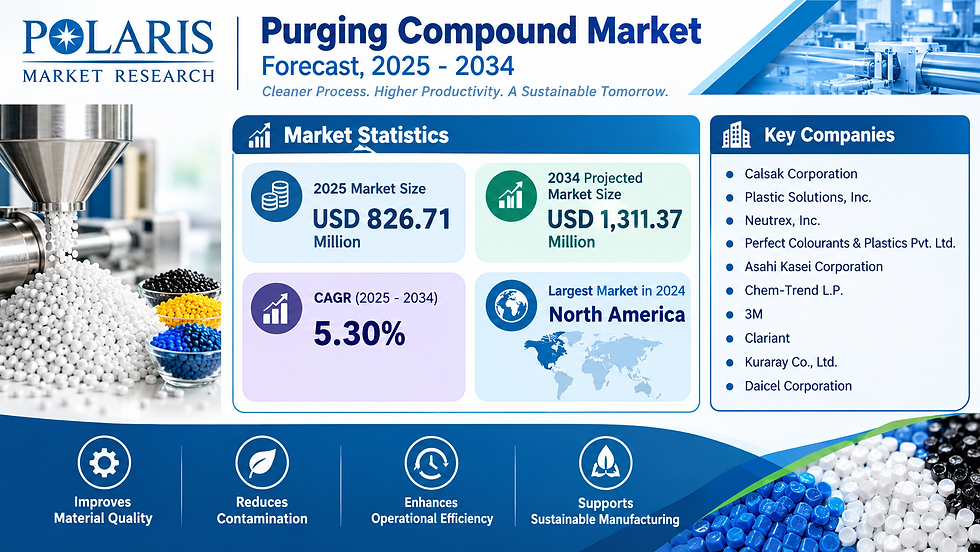
Valued at USD 748.5 million in 2023 and estimated to surpass USD 875.2 million by 2026, the global market is on track to reach an impressive valuation of USD 1,078.1 million by 2030. This upward trajectory corresponds to a steady CAGR of 5.3% over the forecast period from 2024 to 2030. As high-value resins, engineering thermoplastics, and multi-layer packaging structures dominate conversion lines, the strategic implementation of commercial purging compounds serves as a frontline defense against unnecessary downtime, thermal resin degradation, and carbonaceous contamination.
This comprehensive market analysis explores the foundational mechanics, macro growth drivers, market segmentation, competitive forces, and long-term outlook shaping the international purging compound space.
Executive Market Overview 📊
A purging compound is an engineered resin-based cleaning formulation explicitly formulated to purge thermoplastic processing equipment, including injection molding machines, continuous extruders, and blow molding units. Unlike regrind or standard commodity resin used for purging, specialized commercial formulations combine active polymer carriers, specialized scrubbing additives, chemical foaming agents, and surfactant packages. These components effectively scour, clean, and lift degraded polymer build-up, black specks, and stubborn pigments from barrel walls, screw flights, check rings, and hot runner nozzles.
Historically, industrial plastic processors relied heavily on cheap commodity resins, regrind, or manual machine teardowns to switch colors or polymer formulations. However, manual cleaning cycles waste valuable production hours and risk mechanical damage to highly polished screw barrels and tooling surfaces. The economics of contemporary plastics processing render these traditional methods obsolete.
The purging compound market is propelled by the rapid scale of precision manufacturing across the automotive, packaging, consumer electronics, and healthcare verticals. The global baseline market size stood at USD 748.5 million in 2023, exhibiting strong resilience through macroeconomic cycles. By dramatically shortening changeover times and lowering scrap rejection rates, commercial purging compounds yield immediate return on investment for plant operators. Furthermore, growing regulatory compliance around food contact materials and sterile medical consumables has elevated the mandatory cleanliness benchmarks across global processing plants.
🌐𝐁𝐫𝐨𝐰𝐬𝐞 𝐅𝐮𝐥𝐥 𝐈𝐧𝐬𝐢𝐠𝐡𝐭𝐬:
Key Market Growth Drivers ⚙️
The global demand for commercial purging formulations is accelerating due to compounding pressures on manufacturing operational expenditures and equipment uptime. Leading growth drivers include:
Urgent Need to Reduce Machine Downtime: Production line switchovers between deep colors or incompatible polymers often require hours of processing time when utilizing virgin polymer purges. Specialized mechanical purging compounds and chemical purging compounds cut equipment cleanout times by up to 70%, boosting overall equipment effectiveness and production uptime.
Escalating Resins and Raw Material Costs: The cost of engineering resins such as polyamide, polycarbonate, polyether ether ketone, and polybutylene terephthalate continues to rise. Wasting hundreds of pounds of prime resin to purge an extrusion barrel creates severe financial leakage. Commercial compounds clean barrels using a fraction of the material volume.
Surge in Stringent Hygiene and Contamination Standards: Regulatory oversight from authorities like the FDA, EFSA, and international pharmacopeias demands zero cross-contamination in food packaging and pharmaceutical medical devices. Purging compounds eradicate carbonized polymer deposits, preventing particulate migration into critical medical-grade components.
Rapid Expansion of Automotive Lightweighting: Automotive original equipment manufacturers increasingly specify lightweight thermoplastics for under-the-hood, structural, and interior parts. The high temperatures and complex additives involved in processing these technical resins necessitate high-performance purging solutions that resist thermal breakdown.
Heightened Focus on Sustainable Manufacturing and Scrap Reduction: Global carbon neutrality initiatives and circular economy laws penalize excess plastic scrap generation. Efficient purging compounds reduce startup scrap and contaminated off-spec parts during color or resin transitions, directly lowering plant carbon footprints.
Key Market Dynamics 🔄
Understanding the behavioral forces across the supply chain reveals how converters and formulators interact under shifting market requirements:
Transition from Mechanical to High-Tech Hybrid Solutions: While traditional mechanical friction remains popular for basic extrusion, processors running intricate hot runners and tight-tolerance injection molds increasingly require low-residue, non-abrasive hybrid formulations that clean chemically without mechanical wear.
Just-In-Time Production Cycles: Brand owners frequently change consumer packaging designs, labels, and seasonal aesthetic colors. Molders must run shorter, high-mix, low-volume production batches, multiplying daily machine switchovers and increasing steady demand for fast-acting purging agents.
Integration with Preventive Maintenance Schedules: Leading processors no longer treat purging as a reactive fix for black speck contamination. Instead, modern facilities integrate purging compounds into automated shutdown and sealing routines, protecting screws from oxidation and thermal degrade during overnight or weekend stoppages.
Price Sensitivity Versus True Total Cost of Ownership: A persistent dynamic in developing manufacturing hubs is operator resistance to the initial unit price of commercial purges compared to standard resin. Tier-1 molders counter this by quantifying total operational cost reductions in labor hours, energy usage, and scrap waste.
Market Challenges and Strategic Opportunities 💡
Operational and Commercial Challenges
High Initial Material Costs: Premium chemical and liquid purges carry higher per-pound price tags than commodity resin regrind, creating friction among cost-conscious small-to-medium enterprises.
Lack of Operator Training and Standardization: Improper purging temperatures, incorrect soak times, or running incompatible purging grades through narrow hot runner gates can cause nozzle clogs, tool damage, and production delays.
Regulatory Restrictions on Chemical Additives: Formulators face expanding restrictions regarding Volatile Organic Compounds and chemical foaming agents, necessitating continual reformulation of traditional chemical purges to satisfy global environmental standards.
Transformative Industry Opportunities
Development of Bio-based and Biodegradable Purges: As the bio-plastics market expands, processors running PLA, PHA, and bio-composites need specialized, environmentally friendly purging compounds that align with strict compostability and green chemistry certifications.
High-Temperature Engineering Polymer Purging: The rise of aerospace and medical 3D printing filaments and injection-molded PEEK, PEI, and PPS components presents an untapped premium segment for purges capable of operating safely at temperatures exceeding 350°C.
Customization and Tailored Service Models: Purging compound manufacturers have an enormous opportunity to provide site-specific technical audits, resin testing, and custom concentrates that address unique tool geometries and polymer blends.
🌐𝐁𝐫𝐨𝐰𝐬𝐞 𝐅𝐮𝐥𝐥 𝐈𝐧𝐬𝐢𝐠𝐡𝐭𝐬:
Comprehensive Market Segmentation 🧩
The global purging compound market is structurally segmented by product type, conversion process, and geographic region:
By Product Type
Mechanical Purging Compounds: This segment held the leading revenue share of 46.3% in 2023. Mechanical compounds utilize high-viscosity shear, specialized non-abrasive fillers, and mechanical friction to physically scour away residue from screw roots and barrel linings without chemical foaming. They are widely used due to versatility across various resin types and continuous processes.
Chemical Purging Compounds: Expanding at a notable compound rate, chemical purges rely on heat-activated foaming agents and chemical cleaning packages that expand into low-pressure flow areas, microscopic barrel crevices, and complex hot runner systems where mechanical shear cannot reach.
Liquid Purging Compounds: Highly concentrated liquid formulations that can be dosed directly into standard carrier resins at the hopper. They offer storage efficiency, flexibility, and minimal warehouse space requirements for facilities running diverse polymer grades.
By Conversion Process
Injection Molding: Injection molding accounts for the largest application footprint. Rapid cycle times, intricate mold cavities, tight pin-gates, and frequent multi-cavity color transitions demand high-precision cleaning agents to protect expensive hot runner tooling.
Extrusion Processing: Covering blown film, cast sheet, pipe, tubing, and compounding profiles. Extrusion lines require high-volume purging materials that clear high-torque screws, barrel mixers, and wide sheet dies without causing bubble collapse or webbing failure during transition.
Blow Molding: Critical for high-output hollow containers, personal care packaging, and consumer bottles where streaks, haze, or wall pinholes result in instant part rejection.
By Geographic Region
Asia Pacific: Held the dominant global revenue share of 36.1% in 2023. Strong growth in regional automotive production, consumer electronics assembly, and expanding packaging manufacturing in China, India, Japan, and South Korea position Asia Pacific as the primary production engine.
North America: Accounted for 26.4% of the global market revenue in 2023. Robust investments in medical device manufacturing, advanced food-grade packaging automation, and automotive retooling for electric vehicle components underpin steady commercial demand in the United States and Canada.
Europe: Driven by stringent circular economy regulations, sustainability mandates, and precision automotive engineering across Germany, Italy, and France, leading to rapid adoption of low-emission, highly recyclable purges.
Latin America and Middle East & Africa: Emerging manufacturing clusters and expanding domestic plastic transformation facilities are gradually transitioning from basic mechanical scrap purges to commercial formulations.
Key Market Companies 🏢
The competitive landscape of the global purging compound industry features prominent chemical enterprises, specialized compounding formulators, and global materials science innovators. Leading companies shaping market supply, intellectual property, and distribution include:
Asahi Kasei Corporation (Asaclean): A preeminent global market leader known for comprehensive mechanical, chemical, and concentrate grades tailored for injection molding and extrusion tooling.
Chem-Trend L.P. (Freudenberg Group): Renowned for its Lusin brand of mold maintenance and Ultra Purge commercial purging compounds engineered to optimize cycle times and tooling lifespans.
Clariant AG: A specialty chemical titan providing performance additive masterbatches, color-change solutions, and high-efficiency cleaning compounds.
3M Company: Leveraging deep surface chemistry expertise to manufacture specialty fluoropolymer and polymer processing additives that accelerate purge cycles.
Neutrex, Inc. (Purgex): A specialized global leader offering chemically active mechanical purge concentrates that protect check rings, barrels, and hot runner molds.
Daicel Corporation (Placlean): Leading Japanese material sciences provider focused on high-performance resin cleaning compounds that resolve complex thermal degradation issues.
Kuraray Co., Ltd.: Provider of specialty resin systems and functional polymer cleaning agents designed for precision plastic converters.
Calsak Corporation: A key distributor and compound formulator delivering reliable material transition products across multiple processing verticals.
Plastic Solutions, Inc.: Innovator in custom purging solutions engineered to streamline plant efficiency and minimize scrap volume.
Perfect Colourants & Plastics Pvt. Ltd.: A prominent regional player expanding market access across fast-growing Asian manufacturing hubs with cost-competitive formulations.
Strategic mergers and organizational consolidations remain prevalent. For instance, Asahi Kasei consolidated its Asaclean Americas purging unit with Asahi Kasei Plastics North America to create cross-functional supply chain synergies, expand technical customer support, and capture rising demand for advanced compounding solutions.
Emerging Market Trends 📈
Technological innovations and industrial internet-of-things advancements are reshaping how modern facilities deploy purging chemicals:
Artificial Intelligence and Smart Machine Purging: Advanced injection molding presses now incorporate AI-driven optical sensors and barrel monitoring systems that assess screw cleanliness in real time. Rather than relying on operator guesswork, algorithmic controllers dispense precise volumes of purging compound, minimizing changeover scrap.
Formulations Engineered for Multi-Layer Barrier Packaging: The proliferation of barrier films combining EVOH, polyolefins, and polyamides presents severe purging challenges due to divergent melting points. Formulators are introducing universal chemical purges capable of cleaning multi-resin systems across wide processing temperature windows.
Non-Abrasive Formulations for High-Gloss Finishes: The consumer electronics and luxury cosmetics industries demand defect-free, mirror-finish component surfaces. Suppliers are developing chemical purges that leave zero microscopic residue or barrel scratching, preventing haze or surface streaking on optical-grade parts.
Comprehensive Machine Sealing Compounds: Leaving empty barrels exposed to ambient oxygen during plant shutdowns causes rapid polymer carbonization. Modern purging compounds are increasingly engineered to serve as heat-stable thermal seals, preventing oxidation and facilitating instant, streak-free equipment startups on Monday mornings.
Future Outlook: The Road to 2030 🔮
The journey toward USD 1,078.1 million by 2030 illustrates the vital role purging chemistry plays within the broader manufacturing economy. As plastic processors navigate volatile raw material supply chains, escalating energy prices, and tight environmental mandates, operational waste is no longer tolerated. Plants that integrate high-performance purging agents directly into standard operating procedures achieve higher throughput, superior machine longevity, and lower reject rates.
Moving forward, material formulators who invest in low-VOC, circular-friendly, and high-temperature purges will secure long-term market advantages. The transition toward smart processing will see purging agents paired with predictive maintenance protocols and digital asset monitoring. For processors committed to engineering excellence, operational agility, and environmental responsibility, purging compounds will remain an essential strategic asset in delivering sustainable profitability.


Comments