Global Silica Flour Market Set to Reach USD 1,017.67 Million by 2034, Powered by Flourishing Construction Sector and Expanding Industrial Applications, Reports Polaris Market Research
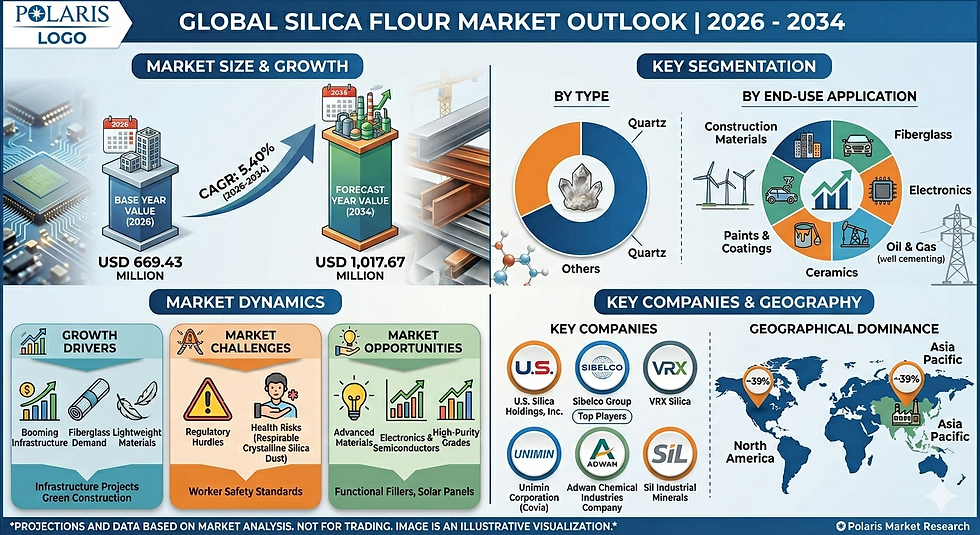
According to the latest comprehensive study published by Polaris Market Research, the global silica flour market is experiencing highly favorable upward momentum. The market, which is valued at USD 669.43 million in 2026, is projected to reach USD 1,017.67 million by 2034, witnessing a steady and robust Compound Annual Growth Rate (CAGR) of 5.40% during the forecast period extending from 2026 to 2034.
The publication titled "Silica Flour Market Size, Share & Growth Analysis Report, 2034" underscores that the market expansion is deeply rooted in the substance’s multi-industry utility, high structural performance capabilities, and irreplaceable chemical characteristics.
Market Overview
Silica flour is an extremely fine, white powder manufactured from crystalline silica typically sourced from natural quartz or high-quality industrial sand. The processing of this essential mineral involves the careful selection of raw quartz with minimal impurities, which is then meticulously reduced using advanced machines like ball mills and jet mills. This ensures a highly uniform particle size distribution and a powder brightness that satisfies the strict purity demands of premium manufacturing industries.
Boasting an exceptional silicon dioxide ($SiO_2$) content typically exceeding 99 percent, silica flour stands out due to its high strength, unique hardness, distinct chemical resistance, and a remarkably high melting point of approximately 1,710 °C. Because it features a smooth, easily blendable texture, it is extensively adopted as a highly effective functional filler, strength enhancer, or performance-improving additive. It is found across everyday technologies, the buildings we occupy, and the infrastructure supplying vital energy to modern cities worldwide.
Key Growth Drivers
The growth trajectory of the global silica flour market is primarily fueled by structural surges across major industrial verticals:
Flourishing Construction and Infrastructure Sectors: The prominent catalyst pushing the consumption of silica flour is its extensive integration into building materials like concrete, bricks, mortars, and grouts. Silica flour provides exceptional properties, including heavily enhanced mechanical strength, improved durability, and superb resistance to chemical attacks, making it a critical additive for modern masonry. Global construction outputs have surged intensely, expanding from USD 6.4 trillion in 2020 to USD 8.2 trillion in 2022.
Massive Infrastructure Investments in the United States: Highlighting the scale of regional construction demand, the Associated General Contractors of America (AGC) reported that the U.S. builds structures valued at roughly USD 1.8 trillion every year, with over 0.92 million construction establishments finalized in the first quarter of 2023 alone. This rapid pipeline of commercial and residential projects secures consistent product demand.
Surging Needs within the Fiberglass Industry: The fiberglass market is seeing escalating demand for silica flour, primarily in the United States. Fiberglass manufactured using silica flour is deployed extensively across high-performance applications, including automotive components, aerospace parts, and wind turbine blades, as the powder fundamentally improves the tensile strength and overall physical performance of the final fiberglass product.
Market Challenges and Opportunities
Challenges:
Despite a highly positive industrial growth outlook, the silica flour market faces challenges stemming from occupational hazards. Crystalline silica remains one of the most prominent and dangerous workplace risks to employees' health. Prolonged exposure to respirable crystalline silica dust can lead to serious respiratory issues. This severe risk necessitates that processing plants and construction sites invest heavily in regulatory safety compliance, strict dust-control management systems, and specialized handling machinery, which can act as a financial barrier for smaller regional processors.
Opportunities:
Conversely, massive opportunities are rapidly emerging as high-precision sectors continue to integrate pure silica flour into advanced technologies. The electronics sector specifically semiconductor fabrication and optical fiber manufacturing has experienced an unprecedented surge in demand for high-purity silica flour. Furthermore, the pharmaceutical and cosmetics industries are increasingly relying on silica flour as an effective excipient in advanced formulations. It is highly valued in these industries due to its non-toxic, affordable, and highly efficient properties, alongside its capacity to drastically improve the flow characteristics and long-term stability of specialized drugs and cosmetic products like toothpaste and sunscreens.
𝐄𝐱𝐩𝐥𝐨𝐫𝐞 𝐓𝐡𝐞 𝐂𝐨𝐦𝐩𝐥𝐞𝐭𝐞 𝐂𝐨𝐦𝐩𝐫𝐞𝐡𝐞𝐧𝐬𝐢𝐯𝐞 𝐑𝐞𝐩𝐨𝐫𝐭 𝐇𝐞𝐫𝐞:
Market Segmentation
To provide granular insight into the industry, the market is broadly divided by material type, end-use application, and geographic region:
By Type Analysis: The market is categorized into Quartz and Others. Among these, the Quartz segment successfully held the largest share in the market. The absolute dominance of this segment is closely linked to the significant influence that quartz types exert over the ultimate physical and chemical characteristics of the final silica flour, encompassing key performance indicators like particle size distribution, color brightness, and chemical reactivity.
By End-Use Analysis: The versatile powder crosses into a massive array of daily and heavy industrial items. Key application spaces include Construction Materials (Concrete, Bricks, Mortars, Grouts), Fiberglass, Electronics (Computer Chips, Semiconductor Elements), Optical Fibers, Household items (Paints, Cat Litter), Personal Care (Toothpaste, Sunscreen), Food & Beverage (Powdered Spices, Dairy Products), and Sports equipment.
Regional Analysis
Geographically, the report highlights the strategic movements occurring within major global regions, emphasizing North America and the Asia-Pacific region.
North America, led heavily by the United States, represents a highly mature and booming consumption base. The region's expansion is fortified by massive continuous investments in commercial construction and a massive aerospace and automotive sector requiring advanced fiberglass materials. Furthermore, the regional demand is sustained by consistent infrastructural requirements across domestic manufacturing grids.
The Asia Pacific region remains a critical engine for market growth. The region's expanding populations and rapid urbanization are triggering heavy industrial expansions. Emerging economies are experiencing a manufacturing boom following the economic challenges of 2020, boosting the demand for silica flour within the regional glass, cement, foundry, and electronics sectors.
Key Companies Profiles
The market features a competitive landscape of primary raw material producers and precision processing companies. Key industry players continually focus on executing advanced testing methods to check each batch for brightness and to verify that there are no unwanted materials or trace metals contained within the powder. This rigorous screening ensures that the product has very low amounts of iron (Fe), titanium (Ti), or aluminum (Al) oxides, which could otherwise reduce clarity or alter electricity conductivity in advanced electronics and specialized glassmaking. Major producers mentioned in related industrial silica research include global entities like:
U.S. Silica
Sibelco
VRX Silica
Fairmount Minerals
Unimin Corporation
Badger Mining Corp
Hi-Crush Partners
Summary of PR
In summary, the global silica flour market is on a robust growth pathway, projected to expand steadily at a CAGR of 5.40% from 2026 through 2034, moving from its 2026 valuation of USD 669.43 million to reach USD 1,017.67 million. Highly regarded for its 99%+ chemical purity, thermal stability up to 1,710 °C, and mechanical strength, this micronized powder has become an invaluable asset for global infrastructure projects, advanced electronics, and daily consumer goods. While crystalline silica exposure presents serious health challenges that require rigorous workplace monitoring, the rising reliance on high-strength concrete, semiconductor chips, and fiberglass assures a prosperous future for global silica flour manufacturers.


Comments