Humanoid Robot as a Service Market Analysis: Navigating Growth, Forecasts (USD 27.63 Billion by 2034 at 42.11% CAGR), and Industry Evolution
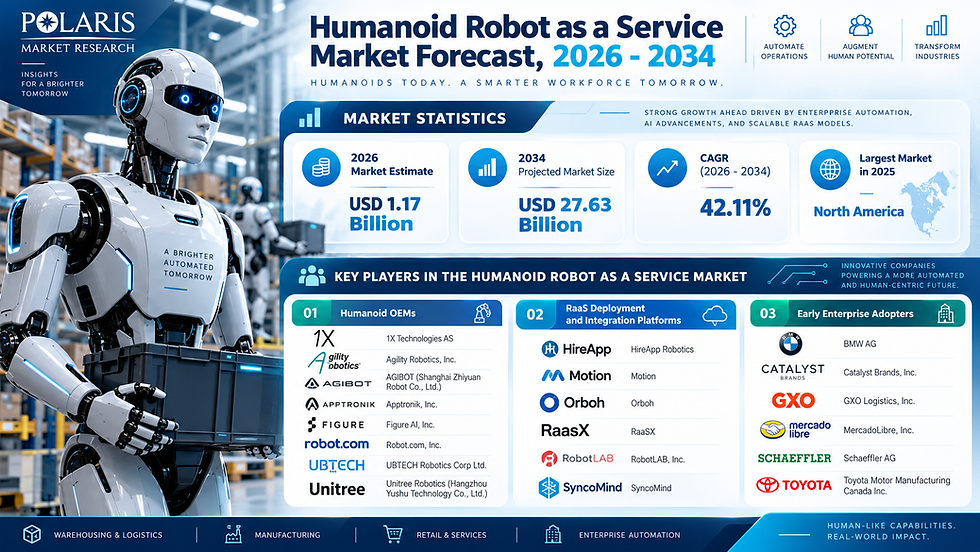
The Humanoid Robot as a Service (RaaS) market is rapidly transitioning from experimental pilots into enterprise-grade deployments. Valued at USD 0.79 billion in 2025, the market is projected to reach USD 27.63 billion by 2034, expanding at an impressive CAGR of 42.11% from 2026 to 2034. Driven by recurring RaaS adoption, commercial pilot conversions, fleet scaling, physical AI advances, and an insatiable demand for flexible robotic labor, organizations worldwide are rethinking automation deployment models.
Market Overview and Economic Context
The Humanoid Robot as a Service Market comprises recurring commercial arrangements where customers access humanoid robotic capabilities without purchasing the underlying hardware outright. These service structures can utilize monthly subscriptions, leases, hourly charges, task-based pricing, managed fleet arrangements, or outcome-based contracts.
Commercial ecosystems are evolving beyond basic hardware sales. Providers now bundle hardware, autonomy software, task integration, deployment services, teleoperation, maintenance, spare parts, insurance, fleet management, remote diagnostics, software updates, and strict service-level commitments.
In terms of market valuation highlights:
2026 Market Estimate: USD 1.17 Billion
2034 Projected Market Size: USD 27.63 Billion
CAGR (2026 - 2034): 42.11%
Largest Market in 2025: North America (holding 39.28% market share)
🌐𝐁𝐫𝐨𝐰𝐬𝐞 𝐅𝐮𝐥𝐥 𝐈𝐧𝐬𝐢𝐠𝐡𝐭𝐬:
Key Market Growth Drivers
Growing Enterprise Preference for Flexible Robotic Deployment: Enterprises are increasingly trialing humanoids through subscription and RaaS structures rather than outright ownership. Such models reduce front-end capital requirements while transferring maintenance, reliability, software updates, and technology obsolescence risks to service providers. Notable examples include Agility’s multi-year orders for Digit v5 exceeding USD 300 million, mostly structured as RaaS.
Increasing Conversion of Humanoid Pilots into Commercial Deployments: Successful pilot programs are turning into permanent commercial deployments as enterprises gather concrete data on productivity, safety, and task reliability. Following successful trials, deployments like Toyota Motor Manufacturing Canada’s commercial RaaS agreement with Agility illustrate this vital shift.
Expansion of Integrated Humanoid RaaS Services: Bundling robot leasing with integration, maintenance, insurance, fleet management, software, and technical support addresses complex operational requirements within a single commercial framework, minimizing the need for internal robotics teams.
Growing Demand for Consumer Humanoid Robot Subscriptions: Subscription pricing lowers upfront access barriers, scaling humanoid robotics into residential, hospitality, and care applications. For example, 1X’s USD 499-per-month NEO model highlights the rise of consumer-oriented recurring pricing.
Key Market Dynamics & Restraints
High Reliability and Utilization Requirements: Humanoid RaaS unit economics hinge on robots operating reliably across thousands of cycles a demanding threshold. Because continuous industrial processes have zero tolerance for frequent intervention, providers currently absorb the costs of field engineering, spare parts, and software tuning until performance stabilizes.
Evolving Contract Structures: Market participants are actively navigating hardware wear and reliability challenges through service guarantees (such as Motion committing to replacement hardware within 48 hours under its managed model).
Market Challenges and Opportunities
Challenges: High reliability standards, integration complexities, workforce acceptance, safety validation, cybersecurity, and managing software version control across scaling fleets.
Opportunities: Expanding integrated RaaS offerings, scaling consumer subscriptions, transitioning toward pay-per-task robotics, and leveraging physical AI data generated across large operational fleets to continuously improve task models.
🌐𝐁𝐫𝐨𝐰𝐬𝐞 𝐅𝐮𝐥𝐥 𝐈𝐧𝐬𝐢𝐠𝐡𝐭𝐬:
Humanoid Robot as a Service Market Segmentation
Service Model Insights
Monthly Subscription / Lease: Held a 41.72% share in 2025, serving as the leading service model by lowering upfront capital investment and enabling predictable automation spending.
Pay-per-Hour / Pay-per-Task: Expected to register the fastest growth at a 44.38% CAGR during 2026–2034, linking customer payments directly to utilization and completed work.
Managed Fleet Service: Accounted for 24.18% of the market in 2025, combining robotic access with centralized fleet platforms for monitoring health, battery status, software versions, and task allocation.
Robot Type Insights
Full Bipedal Humanoid: Accounted for 34.68% of the market in 2025, driven by its unmatched ability to operate smoothly in human-built environments without facility redesign.
Wheeled Humanoid / Mobile Manipulator: Projected to witness a 37.84% CAGR growth during 2026–2034, fueled by demand for efficient locomotion combined with upper-body manipulation in structured industrial facilities.
Upper-Body Humanoid: Held a 12.85% share in 2025, offering focused manipulation from fixed platforms or existing mobile bases.
Task Class Insights
Material Movement: Held a 29.74% share in 2025, serving as a practical entry point for commercial deployments due to standardized workflows and quantifiable productivity targets.
Pick-and-Place: Comprised 22.86% of the total in 2025, driven by requirements for precise object gripping, sorting, and staging.
Machine Tending: Held 19.63% share in 2025, supporting equipment loading, unloading, and monitoring.
Inspection and Service Tasks: Expected to grow at a 39.18% CAGR through 2034.
Multi-Step General Manipulation: Estimated to surge at a 50.84% CAGR through 2034, fueled by massive leaps in perception, dexterity, and autonomy.
Deployment Stage Insights
Onsite Pilot: Accounted for 38.46% of the market in 2025 as enterprises prioritized practical real-world evaluations.
Scaled Fleet Deployment: Projected to grow at a rapid 53.27% CAGR from 2026 to 2034 as successful pilots mature into multi-facility rollouts.
Proof of Technology: Accounted for 24.37% share in 2025 for evaluating initial technical feasibility.
End Use Industry Insights
Logistics & Warehousing: Accounted for 25.84% of the total in 2025, supported by repetitive material handling and predictable workflows.
Automotive Manufacturing: Projected to grow at a 46.36% CAGR during 2026–2034, driven by pioneers like Toyota and BMW testing humanoids for line-side transportation and workstation activities.
General Manufacturing: Captured 19.62% share in 2025.
Healthcare & Care Support: Held 9.68% share in 2025.
Retail & Distribution: Represented 9.47% share in 2025.
Hospitality & Service: Accounted for 7.84% share in 2025.
Contract Scope Insights
Hardware + Software / Maintenance: Represented 39.46% of the market in 2025, reflecting heavy demand for integrated lifecycle support.
Outcome / Labor Service: Expected to register the fastest growth at a 51.38% CAGR during 2026–2034, linking payments directly to productive hours and completed outputs.
Hardware-Only Lease: Held a 20.18% share in 2025 for organizations maintaining advanced in-house robotics capabilities.
Market Trends
Physical AI Data Advantage: Fleets operating at scale generate crucial task demonstrations, failure records, and environmental variation data, allowing providers to continuously refine autonomy models and reduce intervention costs.
Rise of Pay-Per-Task Commercialization: Moving toward output-based pricing (per tote, pick, inspection, or cycle) is making robotic labor much easier to benchmark against traditional labor pools.
Shift toward Service Revenue Mix: As underlying hardware costs decline, revenue is shifting heavily toward task software, fleet management, maintenance, safety protocols, teleoperation, and lifecycle integration services.
Future Outlook
The Humanoid Robot as a Service market is well on its way to achieving USD 27.63 billion by 2034. With North America currently leading regional adoption (holding 39.28% of the 2025 market) and Asia Pacific registering the fastest regional growth at 49.36% CAGR (supported by massive manufacturing facilities such as UBTECH's 14,000-square-meter Guangxi factory), the future belongs to flexible, scalable, and intelligent robotic labor ecosystems. As uptime Service Level Agreement (SLA) metrics standardize and embodied AI matures, RaaS will cement itself as the foundational backbone of modern industrial and commercial automation.


Comments