HVDC Converter Station Market: Reaching USD 91.7 Billion by 2034 at a 9.4% CAGR⚡
The global energy landscape is undergoing an unprecedented paradigm shift. As countries race to decarbonize their economies, integrate skyrocketing levels of renewable energy, and establish robust cross-border power grids, traditional alternating current (AC) transmission infrastructures are facing physical and economic limitations. Long-distance bulk power transmission requires a more efficient, reliable, and technologically superior alternative. Enter High-Voltage Direct Current (HVDC) systems. At the heart of these modern networks are HVDC converter stations the vital installations that convert electricity between AC and DC formats to enable seamless, low-loss energy transportation over thousands of miles or deep beneath ocean waters.
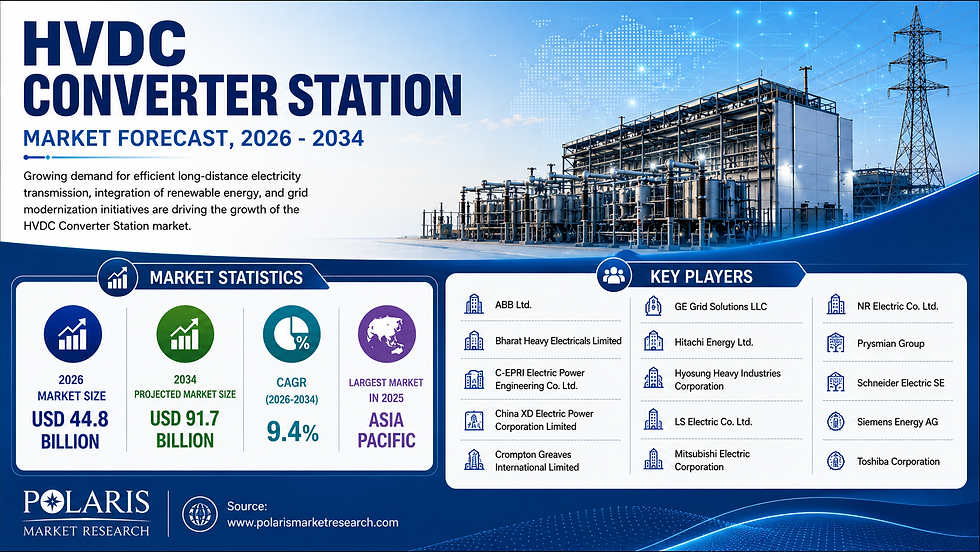
According to a comprehensive industry study published by Polaris Market Research, the global HVDC converter station market size was valued at USD 41.1 billion in 2025. Driven by an urgent push toward grid modernization and the geometric expansion of offshore wind installations, the market is projected to reach an impressive USD 91.7 billion by 2034. This monumental expansion will unfold at a steady compound annual growth rate (CAGR) of 9.4% during the forecast period from 2026 to 2034.
📊 Global Market Overview: The Multi-Billion Dollar Modernization Blueprint
The rapid financial scale-up of the industry emphasizes its status as a critical bottleneck and an ultimate enabler of the global clean energy transition. Moving bulk power over substantial distances via standard AC grids yields massive thermal energy losses, phase instability, and high line impedance. HVDC networks circumvent these problems completely, providing optimal efficiency for long-distance overhead transmissions, underground lines, and subsea cables.
The current baseline market value of USD 41.1 billion reflects substantial existing investments from global utility giants, state-run grid corporations, and cross-national transmission system operators (TSOs). The projected climb to USD 91.7 billion by 2034 reflects a substantial capital expenditure pipeline. Governments are transforming isolated regional grids into hyper-connected, resilient super-grids capable of managing bidirectional, intermittent generation from zero-carbon sources.
🚀 Key Market Growth Drivers
The sustained 9.4% CAGR expected through 2034 is underpinned by several macro-environmental developments. Grid operators are moving past legacy setups to invest heavily in specialized substations.
Accelerated Global Integration of Renewable Energy Sources: The aggressive development of massive solar generation zones, inland wind farms, and centralized renewable energy hubs requires reliable long-distance power transmission infrastructure. These installations are frequently situated in remote geographical locations far from high-consumption urban and industrial epicenters, making efficient bulk transport via HVDC converter stations mandatory.
Aggressive Grid Modernization and Stabilization Initiatives: National utilities and independent power distribution companies are scaling up their capital commitments toward sophisticated HVDC configurations. These investments allow grid architectures to achieve superior operational flexibility, mitigate severe line congestion, balance fluctuating grid loads, and significantly upgrade the macroscopic reliability of electricity distribution networks.
Unprecedented Expansion in Offshore Wind Transmission Infrastructures: The global rush toward building high-capacity offshore wind farms located miles from shorelines has driven significant demand for advanced submarine power transmission facilities. This relies directly on specialized Voltage Source Converter (VSC) installations to manage fluctuating offshore power loads and ensure optimal balancing with mainland grids.
𝐄𝐱𝐩𝐥𝐨𝐫𝐞 𝐓𝐡𝐞 𝐂𝐨𝐦𝐩𝐥𝐞𝐭𝐞 𝐂𝐨𝐦𝐩𝐫𝐞𝐡𝐞𝐧𝐬𝐢𝐯𝐞 𝐑𝐞𝐩𝐨𝐫𝐭 𝐇𝐞𝐫𝐞:
🔄 Key Market Dynamics
The internal mechanics of the infrastructure sector are governed by a unique blend of technological updates, power-electronic innovations, and regulatory milestones.
Transition Toward Power Electronics Dominance: The industry is moving away from old electromechanical components toward sophisticated semiconductor-based topologies. The widespread integration of advanced thyristors, insulated-gate bipolar transistors (IGBTs), and modern power electronics has greatly boosted the total energy throughput and operational reliability of modern converter installations.
Increasing Demand for Interconnected Energy Architectures: As regional electricity markets strive to balance localized supply shortfalls and peak load demands, the structural deployment of back-to-back converter stations and high-voltage cross-border links is growing rapidly.
Subsea and Underground Transmission Prioritization: Due to complex environmental zoning laws and public pushback against traditional overhead lines, transmission projects are increasingly utilizing subsea and underground paths. These alternative layouts depend directly on the specialized capabilities of converter stations to maintain long-range signal and current integrity.
⚖️ Market Challenges and Strategic Opportunities
Even with strong macro growth tailwinds, the global deployment of high-voltage converter hubs involves notable challenges and capital risks.
Significant Industry Challenges
Extremely High Initial Capital Expenditures (CapEx): Building an advanced converter station requires a massive initial investment. Financing the specialized power conversion equipment, extensive civil engineering, security infrastructure, and complex grid integration can delay or limit project approvals in developing regions.
Sophisticated Technical and Interoperability Hurdles: Integrating multi-terminal HVDC grids within existing, legacy AC architectures requires highly complex engineering control systems. Ensuring operational synchronization across components sourced from different technology vendors remains a key technical barrier for many utilities.
Emerging Strategic Opportunities
Next-Generation Modular Multilevel Converter (MMC) Topologies: The ongoing development of highly efficient, smaller, and scalable MMC architectures offers manufacturers an excellent opportunity to reduce total footprint requirements, minimize harmonic distortion, and lower building costs for urban or space-constrained substations.
Strategic Development of Transnational Green Corridors: Massive multinational clean energy initiatives such as connecting remote desert solar installations or subsea offshore networks across entire continents present a multi-billion-dollar project pipeline for engineering, procurement, and construction (EPC) firms and technology providers.
🛠️ Market Segmentation: Technological and Component Breakdown
To fully understand the inner workings of this massive industry, it is essential to segment the market through three core analytical lenses: technology types, structural components, and real-world applications.
By Technology Outlook
The global market is divided into Line Commutated Converters (LCC), Voltage Source Converters (VSC), and Hybrid HVDC Systems.
Line Commutated Converters (LCC): This segment firmly dominated the global market landscape in 2025, capturing a commanding 43.2% of the overall revenue share. LCC setups utilize high-capacity thyristor valves, making them the preferred choice for large-scale, long-distance ultra-high-voltage bulk power transmission projects. Their dominance stems from their exceptional transmission efficiency, mature operational history, and unmatched ability to handle exceptionally high power and voltage levels.
Voltage Source Converters (VSC): While LCC commands the largest historical footprint, VSC technology is projected to exhibit the fastest growth, moving at a CAGR of 10.3% from 2026 to 2034. This fast growth is fueled by the integration of offshore wind assets, black-start capabilities, and the need to stabilize weak AC networks. VSC systems leverage self-commutating IGBT semiconductors, providing independent control over both active and reactive power without requiring an established AC voltage source.
Hybrid HVDC Systems: Blending the raw power handling capability of LCC architectures with the flexible, dynamic control benefits of VSC layouts, hybrid systems are steadily carving out a niche for specialized transmission projects.
By Component Outlook
The technical anatomy of a converter station involves several highly sophisticated, integrated engineering segments:
Converter Valves: Holding the primary position within the component segment, converter valves secured a dominant 31.2% market share in 2025. This large share is driven by the widespread deployment of advanced, semiconductor-based power conversion technologies across global grid installations.
Transformers: Specialized converter transformers are essential for matching the variable voltage outputs of converter configurations to standard AC grid frequencies.
Filters: Both AC and DC filters are vital for smoothing out harmonic distortions and electrical noise generated during high-speed thyristor or IGBT switching cycles.
Control Systems, Cooling Systems, and Switchgear: The remaining market value is distributed across automated digital control rooms, liquid cooling loops for thermal management, and robust high-voltage gas-insulated switchgear (GIS) layouts designed to ensure overall operational safety.
By Application Outlook
The functional deployment of these installations spans several vital utility, civic, and commercial sectors:
Utilities: Representing the largest overall application sector, utility companies drive continuous demand through grid reinforcement, long-range bulk power delivery, and nationwide electrification updates.
Offshore Wind: A rapidly expanding segment that relies directly on VSC converter architectures to bring offshore wind generation back to mainland hubs.
Cross-Border Interconnections: A key growth sector focused on joining separate geopolitical jurisdictions to enable cross-border electricity trading and enhance overall energy security.
Industrial, Rail Electrification, and Others: Additional deployment use cases include feeding power directly to heavy, energy-intensive industrial plants and securing clean, high-capacity traction power for modern high-speed rail networks.
🌍 Market Trends: In-Depth Country-Wise Regional Analysis
The geographical dynamics of the market highlight a clear divide between rapid, large-scale infrastructure deployment in emerging Asian economies and specialized, offshore-focused grid connections across Europe.
Asia Pacific: The Undisputed Global Growth Engine
Asia Pacific comfortably dominated the global market in 2025, securing a major 41.9% share of the worldwide revenue. This regional strength is driven by large-scale transmission infrastructure investments and ambitious state-backed green energy initiatives.
China: As the global leader in Ultra-High-Voltage (UHVDC) transmission architectures, China continues to build massive, multi-gigawatt long-distance transmission corridors. These projects are designed to transport clean hydro, wind, and solar energy from western inland provinces directly to high-demand economic hubs along the eastern coast.
India: Facing rapid urbanization and expanding industrial sectors, India is heavily investing in high-capacity green energy corridors. The state is deploying major back-to-back and long-distance HVDC systems to stabilize its national grid and optimize the integration of massive regional solar arrays.
Japan and South Korea: These highly industrialized nations are prioritizing advanced subsea HVDC links to connect regional islands, incorporate offshore wind resources, and upgrade older coastal grid networks.
Europe: The Hub for Offshore Interconnections and Subsea Grids
Europe is establishing itself as a highly dynamic market segment, projected to maintain a steady and robust CAGR of 8.9% through 2034. The European market focuses primarily on cross-border market integration and tapping into offshore wind potential.
Germany: Acting as a central hub for European energy transition initiatives, Germany is investing heavily in major north-south corridor projects (such as SuedLink and SuedOstLink). These vital paths are designed to bring clean wind energy from northern coastal areas down to heavy industrial zones in the south.
United Kingdom: Driven by ambitious net-zero targets, the UK is rapidly building offshore subsea converter platforms. These networks link massive North Sea wind assets directly into the domestic transmission grid while scaling up subsea interconnectors to neighboring European nations.
The Netherlands and Norway: The Netherlands is focused on large-scale offshore VSC hub construction, while Norway continues to leverage its extensive hydro-generation assets. Together, they are creating a highly integrated, cross-border subsea grid network via advanced high-voltage links.
North America: Grid Resiliency and Renewable Integration
The North American market is shaped by a strong focus on updating aging utility infrastructure and connecting remote clean energy generation assets.
United States: The US market is seeing a major influx of public and private capital aimed at modernizing its fragmented regional transmission grids. Demand is driven by major merchant transmission lines designed to deliver wind power from the midwest to coastal urban centers, alongside a growing pipeline of offshore wind connections along the Atlantic coast.
🏢 Key Market Companies and Competitive Strategies
The global market features a highly consolidated competitive landscape. Success in this industry demands substantial R&D budgets, deep power-electronics expertise, and the ability to execute complex, multi-year engineering projects.
The prominent industrial leaders and specialized engineering corporations defining the competitive space include:
ABB Ltd.
Bharat Heavy Electricals Limited (BHEL)
C-EPRI Electric Power Engineering Co. Ltd.
China XD Electric Power Corporation Limited
Crompton Greaves International Limited
GE Grid Solutions LLC
Hitachi Energy Ltd.
Hyosung Heavy Industries Corporation
LS Electric Co. Ltd.
Mitsubishi Electric Corporation
NR Electric Co. Ltd.
Leading Competitive Strategies
Continuous R&D in Power Semiconductors: Top-tier players are investing heavily in next-generation wide-bandgap semiconductor devices and highly optimized VSC-MMC architectures to reduce overall energy losses and footprint sizes.
Strategic Partnerships and Joint Consortiums: Because converter station projects involve massive scale and high complexity, manufacturers regularly form strategic consortiums with major civil engineering firms, maritime construction companies, and cable manufacturers to deliver comprehensive, turnkey EPC solutions.
Deepening Focus on Digitalization and Cyber-Resilience: With modern grids relying more on software-driven controls, leading companies are embedding edge-computing diagnostics, predictive maintenance sensors, and advanced cybersecurity protocols directly into their converter station control packages.
🔮 Future Outlook: The Strategic Road to 2034
The future trajectory of the market is intrinsically linked to the global electrification of transport, industry, and building heating systems. As total electricity consumption surges worldwide, old AC grids will struggle to keep pace without major structural upgrades.
By 2034, the market will likely see Voltage Source Converter (VSC) technology approach cost parity with traditional Line Commutated Converter (LCC) configurations, making advanced multi-terminal DC grids a standard global infrastructure choice. Super-grids linking entire continents are moving from conceptual blueprints to real-world engineering projects. Supported by a clear 9.4% CAGR and backed by a USD 91.7 billion long-term market valuation, HVDC converter stations will remain a foundational pillar of the global clean energy future.


Comments