Navigating the Future of the Immersion Cooling Market: Reaching USD 8.23 Billion by 2034 at a 30.99% CAGR 🚀
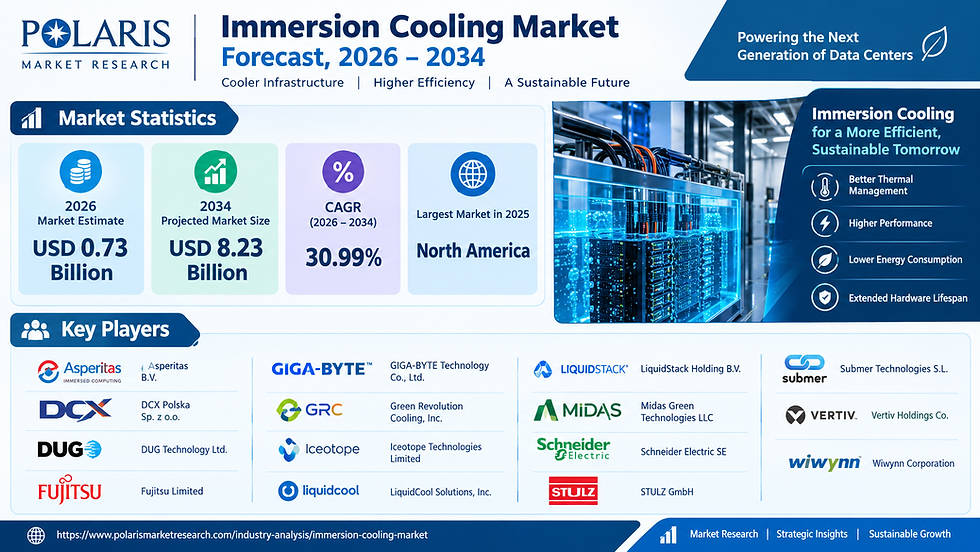
The rapid evolution of high-performance data centers and the surging global demand for heavy electronics and advanced computing devices have fundamentally transformed the thermal management landscape. The global immersion cooling market size was valued at USD 0.54 billion in 2025 and is projected to exhibit a robust CAGR of 30.99% during the forecast period of 2026–2034, scaling up to USD 8.23 billion by the end of 2034, with the 2026 market estimate standing at USD 0.73 billion. As heavy chips, enterprise computers, and AI processors generate unprecedented levels of heat, manufacturers and facility operators worldwide are rapidly adopting immersion cooling solutions.
Market Overview: Transforming Data Center Thermal Management
Immersion cooling is a breakthrough thermal management technology that places computing equipment directly into a non-conductive dielectric fluid. By submerging processors, memory, storage, and other hardware components directly into the fluid, the system transfers thermal energy efficiently through a heat exchanger or alternative cooling infrastructure. This differs fundamentally from traditional air cooling and represents a specialized, high-efficiency segment within the broader data center liquid cooling ecosystem. The market encompasses single-phase and two-phase systems, operating across hyperscale, enterprise, colocation, edge, and specialized computing environments. In 2025, North America emerged as the largest regional market, holding a 34.68% market share, fueled by heavy investments in data center infrastructure and high-density computing. Meanwhile, Asia Pacific is registering rapid expansion, projected to achieve a 33.90% CAGR during 2026–2034, supported by increasing artificial intelligence infrastructure and energy efficiency needs. 📊
🌐𝐁𝐫𝐨𝐰𝐬𝐞 𝐅𝐮𝐥𝐥 𝐈𝐧𝐬𝐢𝐠𝐡𝐭𝐬:
Key Market Growth Drivers
The expansion of the global immersion cooling market is propelled by several critical growth drivers transforming enterprise and hyperscale facilities:
Increasing AI and HPC Rack Density: The rapid proliferation of artificial intelligence and high-performance computing workloads creates severe thermal management challenges. As rack densities measured in kW per rack surge, conventional air cooling hits physical limitations. Immersion cooling of AI data centers enables direct heat extraction from computing equipment into a dielectric coolant, mitigating thermal throttling risks and managing concentrated thermal loads effectively.
Energy Efficiency, PUE, and Water Constraints: Rising concerns regarding energy consumption and water availability drive facility operators toward advanced thermal management technologies. Traditional cooling demands massive mechanical airflow and cooling operations. Immersion systems drastically reduce reliance on air movement through direct heat transfer, improving Power Usage Effectiveness (PUE) and Water Usage Effectiveness (WUE).
Colocation, Edge, and Modular Deployments: The expansion of edge computing, modular data centers, and colocation sites requires compact thermal solutions. Space, noise, environmental, and cooling infrastructure limitations at edge locations accelerate the deployment of immersion tanks and chassis configurations, accommodating diverse workloads across tenant environments. ⚡
Key Dynamics Shaping the Industry Ecosystem
The dynamics of the liquid immersion cooling market involve a delicate balance between advanced technological adoption and operational integration complexities:
Thermal Performance vs. Facility Integration: Operators must weigh the thermal efficiency of single-phase and two-phase systems against facility water loops, floor loading requirements, and coolant distribution units (CDUs). Technology selection depends directly on workload density, equipment compatibility, facility design, and total cost of ownership.
Ecosystem Collaboration: Close cooperation between fluid suppliers, server original equipment manufacturers (OEMs), and infrastructure providers is essential to validate equipment compatibility, meet OEM warranty requirements, and streamline commercial deployments.
Regulatory and Environmental Pressures: Sustainability mandates and evolving chemical regulations, such as the transition toward PFAS-free fluids, shape fluid chemistry choices and drive the development of alternative formulations for sustainable data center operations. ⚙️
Market Challenges and Opportunities
Navigating the adoption landscape requires addressing distinct operational hurdles while capitalizing on emerging avenues:
Hardware Compatibility and Qualification (Restraint): Submerging computing hardware directly into dielectric fluids demands rigorous compatibility testing for components like elastomers, cable insulation, labels, adhesives, connectors, SSDs, memory, and optical transceivers. Securing immersion cooling warranty and OEM certification can extend deployment timelines and raise operational complexity compared to traditional air cooling.
Infrastructure and Retrofit Complexity (Restraint): Retrofitting brownfield facilities involves significant engineering adjustments, including floor loading modifications, fluid handling systems, and service area restructuring. These requirements directly influence the total cost of ownership (TCO) and payback periods.
PFAS-Free Fluids and New Architectures (Opportunity): The rise of PFAS-free dielectric fluid solutions creates lucrative opportunities for fluid manufacturers and system providers. For instance, companies like Orbital Industries have raised funding to scale PFAS-free cooling fluids. Furthermore, innovations such as chassis-level systems offer greater deployment flexibility compared to traditional large tank setups, opening doors across enterprise and edge computing. 🌱
🌐𝐁𝐫𝐨𝐰𝐬𝐞 𝐅𝐮𝐥𝐥 𝐈𝐧𝐬𝐢𝐠𝐡𝐭𝐬:
Comprehensive Market Segmentation Analysis
The immersion cooling market segmentation encompasses type, cooling fluid, application, architecture, component, and region, capturing diverse deployment models:
By Type Outlook: The market divides into single-phase and two-phase immersion cooling. Single-phase systems dominated in 2025, capturing 69.82% of the immersion cooling market share by circulating liquid dielectric coolant. Meanwhile, the two-phase immersion cooling segment is anticipated to register the highest CAGR of 34.30% during 2026–2034, driven by evaporation and condensation mechanisms suitable for extremely dense computing environments.
By Cooling Fluid Outlook: The cooling fluid landscape includes mineral oil, synthetic hydrocarbon fluids, fluorocarbon-based fluids, ester-based fluids, and bio-based dielectric fluids. The mineral oil segment accounted for 43.18% of the immersion cooling market share in 2025 due to its established reliability and proven usage. Concurrently, synthetic hydrocarbon fluids are projected to experience rapid growth with a CAGR of 32.00% during 2026–2034.
By Application Outlook: Applications span across AI data centers, high-performance computing (HPC), enterprise data centers, colocation data centers, cryptocurrency mining, and edge computing. AI data centers dominated the application landscape in 2025 with a 25.36% market share, driven by rising thermal design power (TDP) requirements. The cryptocurrency mining segment is projected to achieve a rapid CAGR of 34.85% during 2026–2034.
By Architecture Outlook: Architectures comprise tank-based and chassis-level systems. Tank-based immersion led the architecture space in 2025 with an 82.64% market share. However, chassis-level immersion is projected to witness the fastest growth with a CAGR of 36.20% during 2026–2034.
By Component Outlook: Components are categorized into solutions and services. The solutions segment dominated in 2025 with 72.36% of market share, encompassing immersion tanks, heat exchangers, and circulation systems. The services segment is projected to be the fastest-growing component category, expanding at a CAGR of 33.80% during 2026–2034.
By Regional Outlook: Regional markets include North America holding 34.68% market share in 2025, Asia Pacific accounting for 28.46% share with a fast CAGR of 33.90%, Europe representing 25.72% share, Latin America holding 6.12% share, and Middle East & Africa accounting for 5.02% share. 🌍
Key Market Trends and Technological Evolution
Several prevailing trends define the trajectory of the data center immersion cooling market. The rapid acceleration of AI infrastructure and rack-level power density increases the urgency for advanced thermal architectures. Operators are actively comparing immersion cooling with direct-to-chip liquid cooling, rear-door heat exchangers, and advanced air systems. Furthermore, the integration of waste-heat recovery systems allows facilities to capture high coolant temperatures for downstream heating applications, aligning economic efficiency with sustainability goals. The industry is also witnessing significant product introductions and strategic partnerships, such as Valeo introducing advanced aluminum cooling technology designed to reduce electrical consumption by 25%, and ongoing innovations in fluid chemistry to support high-density workloads. 📈
Market Key Companies and Competitive Landscape
The competitive ecosystem features prominent pure-play providers, diversified thermal companies, and server original equipment manufacturers. Key industry players include:
Asperitas B.V.
DCX Polska Sp. z o.o.
DUG Technology Ltd.
Fujitsu Limited
GIGA-BYTE Technology Co., Ltd.
Green Revolution Cooling, Inc.
Iceotope Technologies Limited
LiquidCool Solutions, Inc.
LiquidStack Holding B.V.
Midas Green Technologies LLC
Schneider Electric SE
STULZ GmbH
Submer Technologies S.L.
Vertiv Holdings Co.
Wiwynn Corporation
Future Outlook: Projections Toward 2034
Looking ahead, the immersion cooling market is on an aggressive growth trajectory, poised to reach USD 8.23 billion by 2034. As data center operators face mounting pressure to optimize energy usage, lower PUE, and manage extreme thermal loads generated by next-generation processors and AI accelerators, immersion technology will transition from niche deployments to mainstream data center infrastructure. Overcoming hardware compatibility hurdles, standardizing fluid specifications through organizations like the Open Compute Project (OCP), and expanding service ecosystems will unlock new commercial opportunities. Stakeholders across the value chain must balance capital expenditure (CAPEX), operating expenditure (OPEX), and lifecycle economics to secure long-term success in this fast-evolving thermal management sector. 🔮


Comments