Navigating the Global Soda Ash Market: Strategic Insights and Future Trajectories
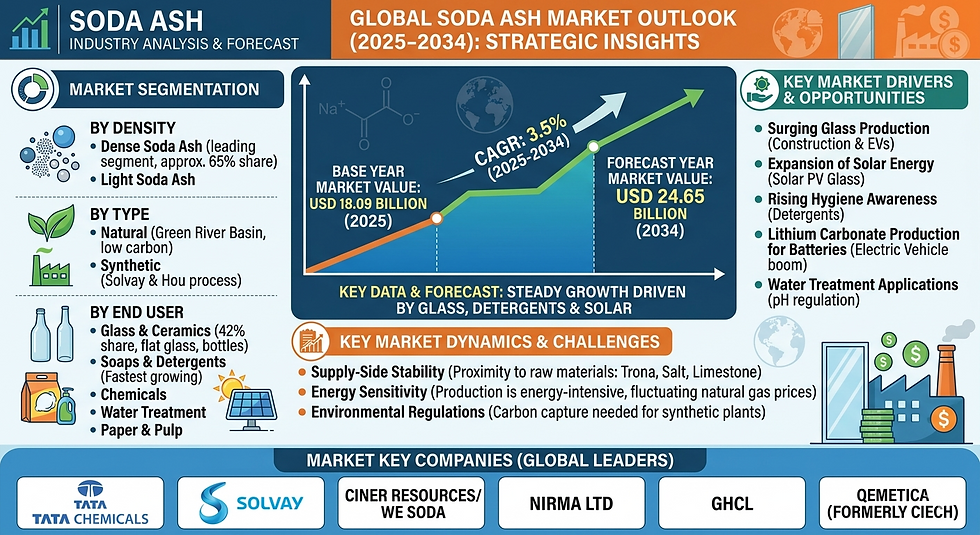
The global chemical industry is currently witnessing a significant shift, and at the heart of this transformation lies soda ash a versatile commodity fundamental to glass manufacturing, detergents, and industrial processing.According to the latest market intelligence from Polaris Market Research, the global soda ash market was valued at USD 18.09 billion in 2025 and is projected to reach USD 24.65 billion by 2034, growing at a steady CAGR of 3.5%. This growth is not merely a result of industrial inertia but is driven by a complex interplay of urbanization, sustainable manufacturing, and evolving consumer standards.
Market Overview
Soda ash, or sodium carbonate, serves as a cornerstone for various manufacturing sectors.The market is bifurcated primarily into natural soda ash derived from trona ore and synthetic soda ash, produced via the Solvay or Hou processes. Currently, the industry is seeing a pronounced tilt toward natural production in regions like North America due to its lower carbon footprint and cost-efficiency. As of 2025, the dense soda ash segment dominates the landscape, commanding roughly 65% of the market share, largely due to its essential role in the production of high-quality glass and heavy-duty detergents.
Key Market Growth Drivers
The upward trajectory of the soda ash market is supported by several foundational pillars:
Surging Glass Production: The construction and automotive industries remain the primary consumers.The shift toward energy-efficient glazing in modern architecture and the rising production of electric vehicles (EVs) have intensified the demand for flat glass.
Expansion of Solar Energy: As the world pivots toward renewable energy, the demand for solar PV glass has skyrocketed. Soda ash is a critical fluxing agent in manufacturing the high-transparency glass required for solar panels.
Rising Hygiene Awareness: In emerging economies, a growing middle class and increased urbanization are driving the consumption of soaps and detergents.Soda ash acts as a vital builder, enhancing cleaning efficiency in varied water conditions.
Technological Innovations: Advances in sustainable production, including carbon capture and sequestration (CCS) integrated into synthetic plants, are allowing manufacturers to meet stringent environmental standards without compromising output.
Key Market Dynamics
The industry operates within a framework of high capital intensity and logistical complexity:
Supply-Side Stability: Market growth is heavily dependent on the proximity of manufacturing hubs to raw materials like limestone and salt (for synthetic) or trona deposits (for natural).
Energy Sensitivity: Production is energy-intensive.Fluctuations in natural gas and coal prices directly impact the operational margins of synthetic soda ash producers.
Strategic Export Hubs: North America and Turkey serve as global "export engines," leveraging vast natural reserves to supply demand-heavy regions like Southeast Asia and South America.
Circular Economy Integration: There is a growing trend of recycling glass (cullet), which reduces the amount of virgin soda ash required per ton of glass produced, prompting manufacturers to diversify their portfolios.
𝐄𝐱𝐩𝐥𝐨𝐫𝐞 𝐓𝐡𝐞 𝐂𝐨𝐦𝐩𝐥𝐞𝐭𝐞 𝐂𝐨𝐦𝐩𝐫𝐞𝐡𝐞𝐧𝐬𝐢𝐯𝐞 𝐑𝐞𝐩𝐨𝐫𝐭 𝐇𝐞𝐫𝐞:
Market Challenges and Opportunities
While the outlook remains positive, players must navigate a landscape of shifting regulations and economic pressures.
Challenges:
Environmental Regulations: Increasing pressure to reduce CO2 emissions poses a significant hurdle for synthetic producers, necessitating expensive upgrades to legacy Solvay plants.
Logistical Vulnerabilities: Given that soda ash is a bulk commodity, disruptions in global shipping routes or rail networks can lead to localized supply shortages and price volatility.
Opportunities:
Lithium Carbonate Production: The battery revolution offers a massive opening.Soda ash is used in the processing of lithium, positioning it as a secondary beneficiary of the global push for decarbonized transportation.
Water Treatment Applications: As global water scarcity increases, the use of soda ash for pH regulation and water softening in municipal and industrial wastewater treatment is expanding rapidly.
Market Segmentation
The soda ash market is categorized to reflect its diverse industrial utility:
By Density: Light Soda Ash and Dense Soda Ash (The latter is the market leader due to its physical properties suitable for glassmaking).
By Type: Natural (lower emission, higher profitability) and Synthetic (wider geographic availability).
By End User:
Glass & Ceramics (Largest segment, approx. 42% share)
Soaps & Detergents (Fastest growing due to hygiene trends)
Chemicals & Metallurgy
Paper & Pulp
Water Treatment
Market Trends: Country-Wise Analysis
The regional landscape is characterized by distinct industrial priorities:
United States: The U.S. remains a global leader in natural soda ash.Driven by the Green River Basin's trona reserves, the market is focused on high-volume exports and supporting a burgeoning domestic solar glass sector.
China: China is the largest producer and consumer of synthetic soda ash. The market trend here is moving toward "Industrial Consolidation," where smaller, less efficient plants are being phased out in favor of large-scale, environmentally compliant facilities.
India: India is experiencing the fastest growth in the detergent and construction sectors. Capacity expansions by major domestic players are aimed at reducing reliance on imports.
Turkey: Leveraging its massive natural reserves, Turkey has emerged as a key competitor to the U.S., focusing on supplying the European and Middle Eastern markets with cost-competitive natural soda ash.
Market Key Companies
The competitive landscape is dominated by a mix of diversified chemical giants and specialized natural resource companies:
Ciner Group
DCW Limited
Eti Soda Elektrik
Fluechem Ltd.
GHCL Limited
Hubei Yihua Group Co., Ltd.
Kayavlon Impex Pvt. Ltd.
Nirma Ltd.
OCI Company Ltd.
Prakash Chemicals International Private Ltd.
Qemetica SA
Sanyo Chemical Industries Ltd.
Solvay
Sudarshan Group
Tata Chemicals
WE Soda Ltd.
Future Outlook
The future of the soda ash market is inextricably linked to the "Green Transition." While traditional glass and detergent applications will provide a stable floor for demand, the real growth acceleration will come from the energy sector. The integration of soda ash into the lithium-ion battery supply chain and the continued expansion of solar infrastructure are expected to redefine the industry’s value proposition over the next decade.
Manufacturers who prioritize "Green Soda Ash" achieved through natural extraction or carbon-neutral synthetic processes will likely secure a competitive advantage as global supply chains increasingly value low-carbon raw materials. As we look toward 2034, the market is set to remain a resilient and indispensable part of the global industrial fabric.


Comments