Unlocking the Future of Genomics: DNA Manufacturing Market Reaching USD 27.62 Billion by 2034 at a 17.7% CAGR 🧬📈
The global life sciences landscape is undergoing a revolutionary transformation, driven by the unprecedented acceleration of gene-based therapies, precision medicine, and synthetic biology. At the heart of this biomedical evolution lies the DNA manufacturing market, which serves as the foundational backbone for cutting-edge therapeutics, modern vaccines, and advanced genetic research.
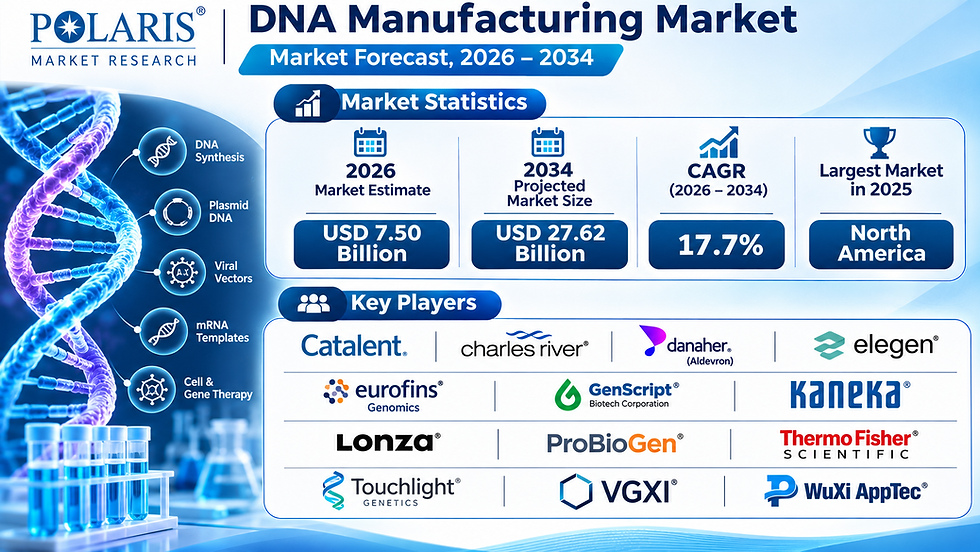
According to recent industry analysis, the global DNA manufacturing market was valued at USD 6.38 billion in 2025 and is projected to reach USD 27.62 billion by 2034, registering a robust CAGR of 17.7% from 2026 to 2034. Furthermore, the market is estimated to hit USD 7.50 billion in 2026, heavily supported by skyrocketing global demand for synthetic DNA, plasmid DNA, and high-grade molecular components across the biotechnology and healthcare sectors.
Comprehensive Market Overview 🌐🔬
The DNA manufacturing market encompasses the large-scale production of customized DNA molecules that empower biotechnology, modern medicine, and foundational scientific research. These essential products include synthetic DNA, plasmid DNA, and specialized DNA vectors utilized extensively in genetic engineering, therapeutic development, and molecular diagnostics. Manufactured genetic material acts as a critical catalyst for advanced medical treatments, functioning as a direct template for producing messenger RNA (mRNA) which subsequently instructs cells to synthesize specific, life-saving therapeutic proteins.
Geographically and structurally, the market exhibits powerful regional leadership and segment concentration. North America accounted for 44.1% of the global DNA manufacturing market revenue in 2025, anchored by a robust biotechnology ecosystem and massive private and public capital deployment into gene-based therapies. Meanwhile, the Asia Pacific region is projected to register a stellar CAGR of 19.8% during the forecast period, supercharged by soaring research and development investments, rapid biotechnology infrastructure expansion, and proactive government genomics support.
From a product and application standpoint, the synthetic DNA segment held the largest market share in 2025, accounting for 60.2% of revenue, propelled by insatiable therapeutic development and diagnostic requirements. Simultaneously, the GMP-grade segment dominated the market in 2025, accounting for 56.6% of revenue, driven by strict clinical-grade compliance mandates for gene therapies, cell therapies, and advanced DNA-based vaccines. By application, the cell and gene therapy segment led the market in 2025, capturing 43.8% of revenue, underpinned by expanding clinical pipelines. Finally, pharmaceutical and biotechnology companies accounted for 48.4% of total market revenue in 2025, while contract research organizations (CROs) are projected to grow at a CAGR of 18.9%, enabling biopharmaceutical developers to outsource production, minimize timelines, and access elite specialized manufacturing capabilities.
🌐𝐁𝐫𝐨𝐰𝐬𝐞 𝐅𝐮𝐥𝐥 𝐈𝐧𝐬𝐢𝐠𝐡𝐭𝐬:
Key Market Growth Drivers 🚀💡
The extraordinary trajectory of the DNA manufacturing market is being catalyzed by several powerful industry growth drivers:
Rising Government Initiatives and Genomics Research: Sovereign backing and nationwide genomics programs are aggressively expanding the need for customized DNA. For instance, the U.S. National Institutes of Health reported that its All of Us Research Program made data from more than 747,000 participants available to researchers, including over 535,000 whole-genome sequences, directly stimulating laboratory and diagnostic DNA demand.
Explosive Integration of Artificial Intelligence (AI): Artificial intelligence is revolutionizing DNA sequence design and streamlining manufacturing workflows. Advanced AI tools empower researchers to accurately assess gene sequences, identify optimal designs, and simulate experiments prior to physical production, curbing redundant laboratory efforts and accelerating synthetic DNA turnaround times.
Surging Clinical Pipeline Expansion: The continuous expansion of global advanced therapeutic pipelines is injecting continuous momentum into the sector. Industry metrics from the International Society for Cell & Gene Therapy highlight active clinical pipelines encompassing hundreds of active trials, all requiring high-purity plasmid DNA and viral vectors.
Expanding Precision Medicine and Genetic Diagnostics: Escalating investments in personalized medicine and molecular diagnostics are driving unprecedented orders for custom gene constructs. Genomic databases allowing the study of genetic variations and disease risks require extensive synthetic DNA components for custom diagnostic assay development.
Key Market Dynamics ⚙️📊
Navigating the contemporary DNA manufacturing market requires a nuanced understanding of core industry dynamics, production methodologies, and operational variables:
The Shift Toward Advanced Production Methodologies: The industry relies heavily on choosing between synthetic DNA and plasmid DNA. While synthetic DNA is chemically or enzymatically synthesized to match precise sequences for gene synthesis and diagnostics, plasmid DNA relies on cellular propagation and stringent purification to serve as circular carriers for gene therapy and vaccine vectors.
Technological Evolution in Synthesis: Biopharmaceutical innovators are rapidly adopting enzymatic DNA synthesis as a sustainable, high-efficiency alternative to conventional chemical oligonucleotide synthesis, helping overcome traditional sequence length and yield barriers.
Outsourcing and CDMO Partnerships: Due to the immense capital expenditure required for internal infrastructure, pharmaceutical enterprises increasingly partner with specialized contract development and manufacturing organizations (CDMOs) and CROs to secure scalable production and specialized technical expertise.
Stringent Quality Control and Compliance Standards: Market participants must continuously optimize supercoiled content, minimize residual impurities and endotoxin levels, and maintain strict adherence to GMP-grade standards to clear regulatory hurdles for clinical-grade commercial deployment.
Market Challenges and Opportunities ⚖️✨
Like any high-growth high-tech sector, the DNA manufacturing market navigates a complex matrix of operational headwinds and lucrative commercial prospects:
Market Challenges
High Manufacturing Costs and Capital Intensity: Fabricating complex, long-chain DNA sequences demands specialized machinery, cleanroom infrastructure, and highly skilled personnel, driving up initial setup expenses.
Scale-Up and Purity Bottlenecks: Scaling production volumes while relentlessly maintaining molecular identity, purity, and batch consistency presents severe technical hurdles, particularly for emerging biotech startups.
Stringent Regulatory Compliance: Meeting rigorous clinical trial documentation and analytical validation standards for therapeutic applications can prolong time-to-market and elevate operational overhead.
Market Opportunities
Cell and Gene Therapy Commercialization: The ongoing transition of gene-based treatments from early-phase clinical trials to commercial-stage approvals unlocks massive long-term demand for dedicated manufacturing partners.
Price Reductions via Cell-Free Platforms: Innovations such as cell-free DNA platforms and advanced enzymatic workflows (e.g., platforms reducing prices down to $0.07 per base pair) are opening new market segments by making custom synthetic DNA far more economically accessible.
Emerging Diagnostic and Agricultural Horizons: Expanding applications into synthetic biology, molecular diagnostics, and agricultural biotechnology provide diversified revenue streams outside traditional human therapeutics.
🌐𝐁𝐫𝐨𝐰𝐬𝐞 𝐅𝐮𝐥𝐥 𝐈𝐧𝐬𝐢𝐠𝐡𝐭𝐬:
Market Key Companies 🏢🏆
Competitive positioning within the global DNA manufacturing market is defined by technological innovation, manufacturing scale, product quality assurance, and global service breadth. The leading industry players driving this market forward include:
Catalent, Inc.
Charles River Laboratories International, Inc.
Danaher Corporation (Aldevron)
Elegen, Inc.
Eurofins Scientific SE (Eurofins Genomics)
GenScript Biotech Corporation
Kaneka Corporation
Lonza Group AG
ProBioGen AG (ProBio)
Thermo Fisher Scientific Inc.
Touchlight Genetics Ltd.
VGXI, Inc.
WuXi AppTec Co., Ltd.
Major life sciences leaders like Thermo Fisher Scientific Inc. provide comprehensive bioproduction and genetic analysis ecosystems. Danaher Corporation, through Aldevron, anchors leadership in specialized plasmid DNA and nucleic acid production for clinical pipelines. Meanwhile, innovative disruptors like Touchlight Genetics Ltd. utilize proprietary cell-free technologies such as doggybone DNA (dbDNA™), and Elegen, Inc. leverages advanced cell-free platforms to redefine turnaround speeds and sequence complexity.
Market Segmentation 🔍📋
The global DNA manufacturing market is comprehensively segmented across multiple dimensions to serve diverse scientific and industrial requirements:
By Type: Segmented into Plasmid DNA and Synthetic DNA, with the latter further broken down into Gene Synthesis and Oligonucleotide Synthesis. The synthetic DNA segment led with 60.2% market share in 2025.
By Grade: Segmented into GMP Grade and R&D Grade, where GMP grade captured 56.6% revenue share in 2025 driven by clinical and commercial validation needs.
By Application: Segmented into Cell & Gene Therapy (leading with 43.8% revenue share in 2025), Vaccines, Oligonucleotide-Based Drugs (projected at a 20.2% CAGR), and Others.
By End Use: Segmented into Pharmaceutical and Biotechnology Companies (commanding 48.4% revenue share in 2025), Academic & Research Institutes, and Contract Research Organizations (CROs).
By Region: Spanning North America (dominating at 44.1% market share in 2025), Europe, Asia Pacific (projected at a 19.8% CAGR), Latin America, and the Middle East & Africa.
Market Trends 📈🔮
Current industry shifts emphasize technological sophistication, speed, and regulatory compliance. Notable recent developments highlight this rapid evolution:
Commercial Readiness and Inspections: Regulatory milestones, such as ProBio successfully completing pre-approval inspections by China's National Medical Products Administration (NMPA) for commercial biologics readiness, demonstrate the maturation of manufacturing facilities.
Clinical Validation of Novel Platforms: Groundbreaking clinical advancements, such as Touchlight’s doggybone DNA (dbDNA™) technology supporting the first UK patient dosing in a Phase I clinical trial for a personalized lung cancer vaccine, showcase the immense potential of cell-free platforms.
Breakthrough Cost Efficiencies: Strategic price compressions across custom DNA portfolios (such as Elegen's ENFINIA™ portfolio scaling down to $0.07 per base pair via the GEN II Cell-Free Platform) are democratizing complex synthetic sequence access for researchers worldwide.
Global Expansion of GMP Infrastructure: Continuous facility expansions, such as ProBio launching GMP plasmid DNA manufacturing services in New Jersey and Touchlight achieving GMP certification in the UK, underline the industry's commitment to clinical-grade standards.
Future Outlook 🌟🎯
Looking toward the horizon, the DNA manufacturing market is poised for exponential expansion, projected to skyrocket to USD 27.62 billion by 2034. The convergence of rising clinical demand for advanced cell and gene therapies, widespread adoption of enzymatic DNA synthesis, and automation-driven high-throughput platforms will continue to redefine production benchmarks.
While market growth will remain tightly bound to careful management of production costs, stringent regulatory compliance, and technological scaling, the future is exceptionally bright. As precision medicine, genomic diagnostics, and synthetic biology transition into mainstream clinical practice, high-quality DNA manufacturing will remain the indispensable bedrock of modern medical innovation.


Comments