Accelerated Processing Unit Market Size Worth USD 105.50 Billion by 2034, Registering a Robust CAGR of 18.89%
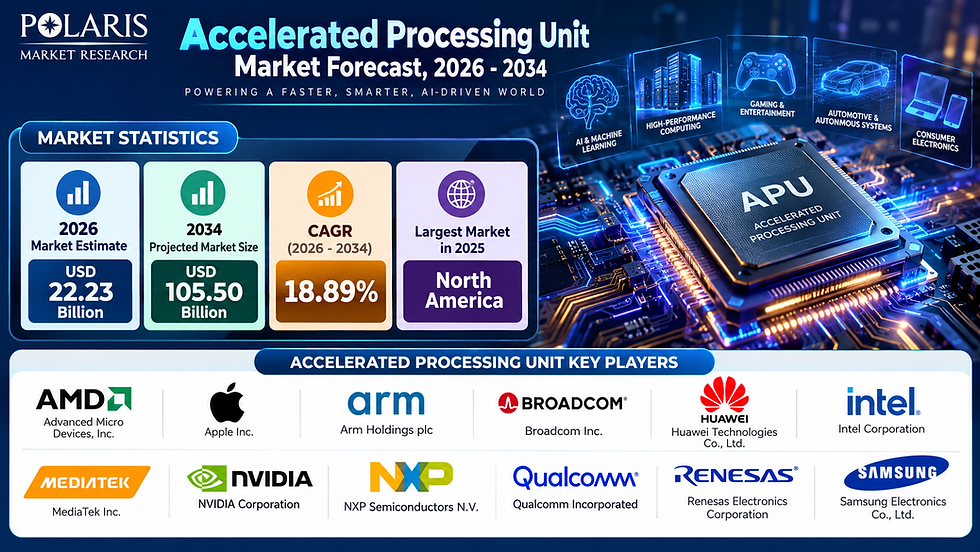
🚀 The Accelerated Processing Unit (APU) Market is experiencing a monumental paradigm shift. According to recent market analysis, the industry was valued at USD 18.32 billion in 2025 and is projected to skyrocket to USD 105.50 billion by 2034, expanding at a remarkable CAGR of 18.89% over the forecast period from 2026 to 2034.
This comprehensive LinkedIn article explores the core drivers, evolving market dynamics, segmentation, and future outlook shaping the semiconductor industry.
Market Overview
The accelerated processing units market encompasses advanced processors that merge Central Processing Unit (CPU) and Graphics Processing Unit (GPU) functions on a single die or package, complemented by dedicated Neural Processing Units (NPUs) or AI engines. By driving heterogeneous computing with fewer separate processing elements, APUs are transforming laptops, desktops, gaming consoles, handheld systems, and edge computing platforms.
In 2025, North America dominated the global market share with 40.18%, anchored by an established ecosystem of key semiconductor designers and robust computing infrastructure. Meanwhile, the Asia Pacific market is forecasted to record the highest growth rate, surging at a CAGR of 21.72%.
🌐𝐁𝐫𝐨𝐰𝐬𝐞 𝐅𝐮𝐥𝐥 𝐈𝐧𝐬𝐢𝐠𝐡𝐭𝐬:
Key Market Growth Drivers
📈 Rising On-Device AI Demand: The rapid migration of workloads from the cloud to local edge devices is fueling immense demand for unified processors capable of handling local AI inference.
🎮 Platform Convergence Across Gaming and Consoles: Long-term custom silicon programs for next-generation gaming consoles (such as PlayStation and Xbox hardware architectures) provide reliable, multi-year demand for integrated CPU-GPU platforms.
💻 Expansion of AI PCs: The sweeping commercialization of AI-capable personal computers requiring integrated neural acceleration is driving rapid hardware refresh cycles across consumer and enterprise segments.
Key Market Dynamics
⚡ Shift in Compute Performance Metrics: Processor comparison is shifting from legacy CPU clock speeds and core counts to NPU capability (measured in TOPS), unified memory architectures, and software ecosystem support.
💰 Memory and Thermal Cost Pressures: Surrounding supply constraints and surging demand for high-bandwidth memory (HBM) in AI data servers have created cost pressures on DRAM and NAND components for mainstream OEM builders.
🌐 Rise of ARM-Based Architectures & Edge Computing: The commercial success of ARM-based integrated SoCs such as Qualcomm’s Snapdragon X platforms and Apple Silicon is expanding architectural diversity in mainstream Windows and macOS computing environments.
Market Challenges and Opportunities
🛑 Software Compatibility Hurdles: Established x86 software ecosystems present a barrier for alternative architectures, requiring extensive optimization for enterprise applications and legacy driver stacks.
📦 Advanced Packaging Constraints: Premium multi-die chiplet and advanced packaging dependencies require immense capital investment and sophisticated supply-chain integration.
☁️ Data Center and HPC Convergence: The convergence of high-performance computing (HPC) and artificial intelligence is opening new revenue streams for tightly coupled processors like the AMD Instinct MI300A.
🌐𝐁𝐫𝐨𝐰𝐬𝐞 𝐅𝐮𝐥𝐥 𝐈𝐧𝐬𝐢𝐠𝐡𝐭𝐬:
Market Segmentation
By Form Factor: Laptop APUs dominated the market in 2025 with a 36.72% share, while Data Center APUs are projected to exhibit the highest growth at a 24.68% CAGR.
By Architecture: x86-Based APUs held the lion's share at 54.86% in 2025, supported by widespread Windows software compatibility, while ARM-Based Integrated SoCs are expanding rapidly at a 23.18% CAGR.
By Application: Personal Computing led the market with 31.84% in 2025, whereas AI PCs are accelerating at a 27.86% CAGR.
By End Use: PC OEMs captured the leading share at 34.72% in 2025, driven by massive volume procurement for consumer and business systems.
By Sales Channel: OEM Supply represented the primary commercial route at 54.68% of the market in 2025.
Market Key Companies
The global competitive landscape is spearheaded by visionary technology innovators shaping modern silicon design:
Advanced Micro Devices, Inc. (Market Leader)
Intel Corporation (Market Leader)
Apple Inc. (Premium Ecosystem Leader)
Qualcomm Incorporated (Challenger in ARM-Based PCs)
NVIDIA Corporation (AI & Client Compute Challenger)
MediaTek Inc. | Huawei Technologies Co., Ltd. | Samsung Electronics Co., Ltd.
Market Trends
The Rise of Heterogeneous SoCs: Modern chip design has evolved beyond standard dual-processor setups into comprehensive systems-on-chip combining high-performance CPU cores, dense graphics engines, and specialized neural accelerators.
Advanced Packaging Innovations: Technologies like Apple's UltraFusion and multi-die chiplet designs are enabling unprecedented transistor density without relying solely on monolithic die fabrication.
Elevated Memory Integration: Unified memory configurations supporting up to 512 GB allow local execution of massive large language models (LLMs) directly on client systems.
Future Outlook
As the semiconductor industry advances toward 2-nanometer process nodes and deeper hardware-software co-design, the definition of processor value is shifting decisively from simple unit volume shipments to raw compute density. With local artificial intelligence scaling across every consumer device, enterprise platform, and data center environment, accelerated processing units will remain the undisputed backbone of next-generation computing infrastructure.


Comments