Global SMS Firewall Market Report: Growth Drivers, Trends, and Future Outlook
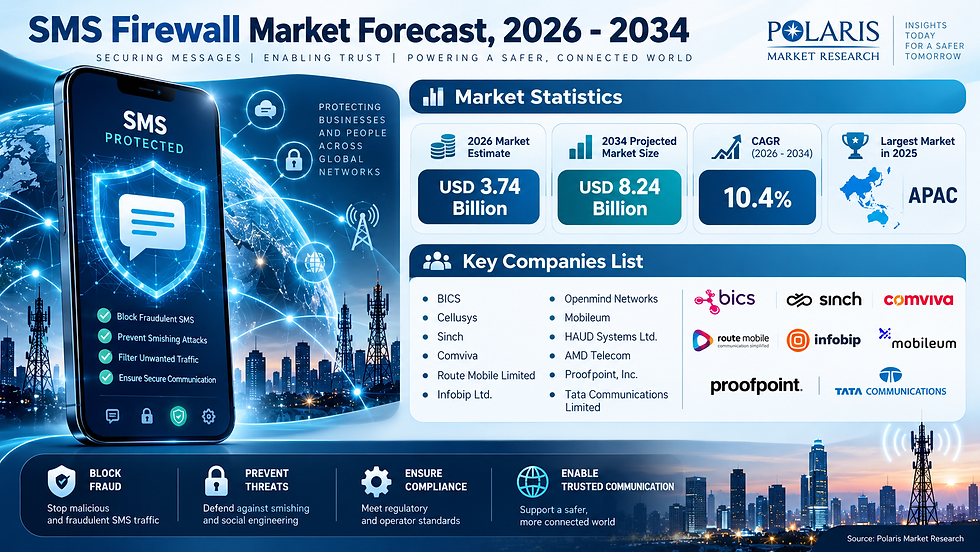
The global messaging landscape is undergoing a critical transformation as mobile operators face an escalating volume of sophisticated threats, alongside surging demand for automated business communications. According to recent industry datasets, the global SMS firewall market was valued at USD 3.41 billion in 2025 and is projected to scale significantly, reaching USD 8.24 billion by 2034, expanding at a robust compound annual growth rate (CAGR) of 10.4% throughout the forecast period.
Market Overview
An SMS firewall operates as a core security and revenue-protection mechanism implemented by mobile network operators and messaging providers to inspect, filter, and direct traffic before it reaches a subscriber's handset. It governs two primary message streams: Application-to-Person (A2P) communications such as multi-factor authentication codes, appointment reminders, and transactional alerts and Person-to-Person (P2P) messaging between individuals.
With fraudsters deploying advanced techniques like AI-driven sender spoofing, SIM-box abuse, and grey-route bypassing, modern firewalls have evolved from supplementary tools into mission-critical infrastructure. They safeguard operator revenues by recovering funds lost to unmonitored traffic routes while simultaneously protecting end users from phishing and smishing campaigns.
🌐𝐁𝐫𝐨𝐰𝐬𝐞 𝐅𝐮𝐥𝐥 𝐈𝐧𝐬𝐢𝐠𝐡𝐭𝐬:
Key Market Growth Drivers
Surging SMS Fraud and Sophisticated Phishing Attacks: The rapid expansion of mobile fraud necessitates advanced filtering. For instance, the Anti-Phishing Working Group recorded 1,003,924 phishing attacks in the first quarter of 2025 alone, forcing operators to move beyond rigid legacy filtering rules toward real-time traffic analysis and machine learning.
Rapid Expansion of A2P Messaging Traffic: Enterprises increasingly rely on automated messaging for operational workflows, verification processes, and marketing campaigns. This massive volume strains legacy architectures, creating high demand for robust management and control solutions.
Regulatory Compliance and Mandatory Carrier Frameworks: Government bodies and telecom regulators worldwide are enforcing stricter guidelines regarding commercial text communications. Frameworks such as the United States 10-digit long code (10DLC) system, India’s TRAI TCCCPR regulations, and European GDPR directives require telecom operators to deploy highly sophisticated inspection tools to monitor compliance.
Need for Operator Revenue Assurance: Grey-route activities where commercial messages bypass normal delivery agreements and termination fees continue to cause financial leakage. Firewalls enable carriers to plug these leaks and protect legitimate revenue streams.
Key Market Dynamics
Shift Toward AI-Based Threat Detection: Traditional rule-based firewalls are increasingly inadequate against modern, fast-evolving fraud patterns. Solution providers are integrating artificial intelligence and automated anomaly detection to successfully identify concealed threats.
Consolidation Through Mergers, Acquisitions, and Partnerships: Industry players are actively combining mobile identity checks, messaging compliance, and security features into unified offerings. For example, Xconnect launched a mobile identity verification platform in the UK for fintech vendors, highlighting a broader industry trend toward cross-selling multi-layered security ecosystems.
Alternative Channel Competition: The rise of Rich Communication Services (RCS) and third-party messaging applications provides alternative enterprise communication channels. While this introduces competition for traditional SMS, leading vendors are successfully future-proofing their offerings by integrating RCS support directly into their modern firewall architectures.
Market Challenges and Opportunities
Challenges:
The continuous evolution of bypass techniques requires vendors to constantly update their threat detection models.
Budget competition from alternative enterprise messaging platforms and RCS investments can influence how quickly smaller operators allocate capital for dedicated SMS security upgrades.
Opportunities:
AI-Led Upgrades: Replacing legacy rule-based systems with real-time, AI-driven platforms opens significant revenue streams for technology vendors targeting mid-sized and tier-1 mobile operators.
Unified Security Solutions: Vendors that bundle SMS firewall capabilities with advanced authentication, customer identity verification, and risk-scoring tools can build stickier, higher-value relationships with telecom operators.
🌐𝐁𝐫𝐨𝐰𝐬𝐞 𝐅𝐮𝐥𝐥 𝐈𝐧𝐬𝐢𝐠𝐡𝐭𝐬:
Market Segmentation
The market is classified across several key dimensions:
By Component: Divided into SMS Firewall Platforms, which dominated the market share in 2025 at 68.5%, and Services (including managed and professional support), which is projected to grow at a fast CAGR of 11.85% as carriers outsource threat monitoring.
By SMS Type: Segmented into A2P Messaging (holding the dominant share of 64.81% due to extensive enterprise use cases) and P2P Messaging, which is anticipated to progress at a CAGR of 8.9%. Additional segmentation covers national versus international traffic.
By Deployment Model: Categorized into On-premise and Cloud-based solutions, with cloud adoption expanding rapidly due to flexibility and faster deployment cycles.
Market Trends
Outsourcing to Managed Security Providers: Smaller and mid-sized carriers are increasingly opting for managed services to handle regular rule updates and threat monitoring instead of maintaining large in-house cybersecurity teams.
Integration with Signaling and Roaming Analytics: Leading telecom operators are demanding that SMS firewalls integrate seamlessly with broader network analytics, including SS7, Diameter, and HTTP/2 signaling security platforms.
Real-Time Template and Header Validation: To comply with strict regional mandates, platforms are increasingly incorporating automated parsing of registered sender IDs, principal entity records, and approved message content templates.
Market Key Companies
The global market features a competitive landscape comprising major telecom connectivity providers, enterprise CPaaS platforms, and specialized security specialists:
BICS
Cellusys
Sinch
Comviva
Route Mobile Limited
Infobip Ltd.
Openmind Networks
Mobileum
HAUD Systems Ltd.
AMD Telecom
Proofpoint, Inc.
Tata Communications Limited
Recent developments underscore this momentum; for instance, AcePeak introduced a carrier-grade enterprise SMS firewall at ITW USA 2026, while PAiCore Technology and TelecomsXchange launched an AI-powered SMS firewall integrating OpenTextShield to deliver real-time spam and phishing protection.
Regional Insights
North America: Led the global market with 37.41% share in 2025, supported by heavy enterprise spending on A2P messaging, widespread adoption of 10DLC systems in the U.S., and well-established regulatory frameworks.
Asia-Pacific: Projected to exhibit the highest regional growth rate at a CAGR of 12.1%. This expansion is fueled by massive mobile user bases in countries like India, Indonesia, and China (where high mobile penetration such as 96.8% among rural Indian youth aged 15–29 recorded in early 2025 generates massive daily message volumes), alongside proactive regulatory efforts to curb spam.
Europe: Expected to grow at a CAGR of 9.8%, driven by diverse national telecom regulations, network modernizations, and strict data protection requirements under GDPR and ePrivacy rules.
Middle East & Africa: Anticipated to expand at a CAGR of 9.5%, supported by growing mobile-money platforms and digital services requiring secure customer authentication.
Future Outlook
The trajectory of the SMS firewall market points toward sustained, steady expansion. As businesses increasingly rely on automated channels and threat vectors grow more sophisticated, mobile network operators will continue prioritizing investments in automated, AI-enabled defense systems. The integration of cloud infrastructure, advanced identity verification services, and cross-channel messaging protection will define the next generation of enterprise telecommunications security.



Comments