Global Antimicrobial Coatings Market Expected to Hit USD 45.2 Billion by 2034, Expanding at a Rapid 13.80% CAGR
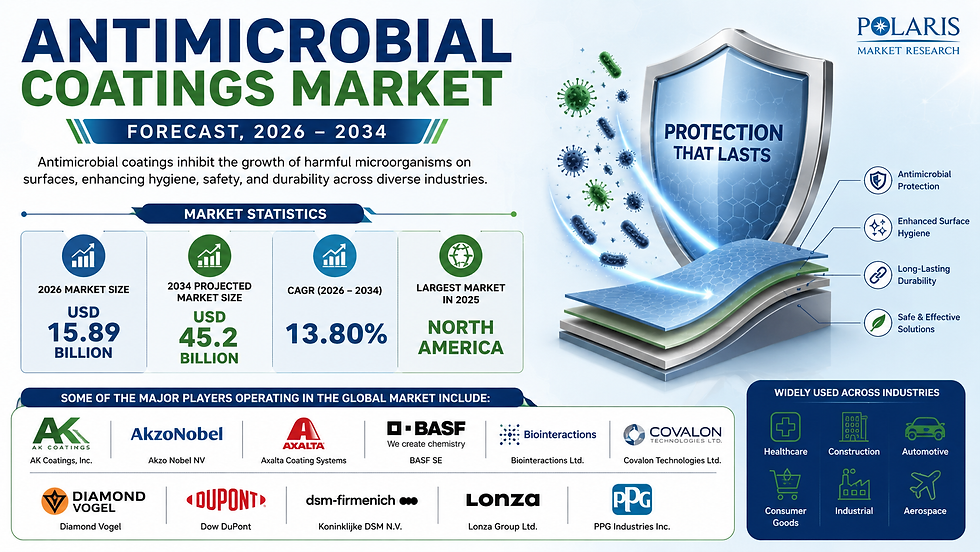
The global surface protection sector is witnessing an unprecedented transition as infection control, bio-safety, and surface hygiene move from optional enhancements to non-negotiable operational imperatives. Modern industrial, clinical, and commercial environments increasingly demand advanced protective mechanisms to counteract microbial accumulation, surface contamination, and escalating microbial resistance. In response to this rising necessity, the antimicrobial coatings market is experiencing sustained commercial acceleration. According to comprehensive market intelligence, the global market valuation reached USD 14.0 billion in 2025 and reached USD 15.89 billion in 2026. Demonstrating exceptional long-term momentum, the market is on track to achieve a projected revenue valuation of USD 45.2 billion by 2034, advancing at a robust compound annual growth rate (CAGR) of 13.80% throughout the forecast period from 2026 to 2034.
Antimicrobial coatings represent specialized formulations designed specifically to impede the proliferation of pathogens, fungi, bacteria, and microbial impurities on vulnerable contact surfaces. These formulations function by integrating proactive chemical or elemental agents that alter interfacial surface characteristics, destroying or inhibiting pathogens upon direct contact while simultaneously boosting substrate durability, aesthetics, and corrosion resistance. The scope of adoption extends across high-consequence environments including healthcare infrastructure, food processing facilities, public transport, educational buildings, and modern architectural systems. Heightened institutional awareness surrounding hospital hygiene, stringent regulatory standards, and consumer demand for hygienic consumer products continue to propel market expansion worldwide.
Historically valued and measured through baseline datasets across the 2021 to 2024 period, the sector has established itself as an indispensable multi-billion-dollar global pillar. In 2025, North America established market leadership, capturing a 34.0% revenue share, driven by rigorous clinical infection control protocols and rapid commercialization of advanced surface coatings. Meanwhile, the Asia Pacific region is anticipated to expand at the fastest pace, charting an impressive CAGR of 14.8% across the forecast window, propelled by immense population demographics, burgeoning commercial infrastructure, and expanding manufacturing bases.
𝐄𝐱𝐩𝐥𝐨𝐫𝐞 𝐓𝐡𝐞 𝐂𝐨𝐦𝐩𝐥𝐞𝐭𝐞 𝐂𝐨𝐦𝐩𝐫𝐞𝐡𝐞𝐧𝐬𝐢𝐯𝐞 𝐑𝐞𝐩𝐨𝐫𝐭 𝐇𝐞𝐫𝐞:
📈 Key Market Growth Drivers
The market's acceleration toward USD 45.2 billion is steered by structural, clinical, and technological tailwinds across modern supply chains:
🏥 Rising Demand to Eliminate Healthcare-Associated Infections (HAIs): Healthcare facilities, acute care units, and hospitals globally encounter persistent complications linked to pathogen transmission on clinical contact surfaces. Utilizing protective coatings on high-touch furniture, surgical tools, clinical devices, and wall panels actively suppresses cross-contamination, establishing these solutions as frontline defenses in modern clinical protocols.
🧬 Surging Challenges Posed by Antimicrobial Resistance (AMR): With antimicrobial resistance escalating into an acute global challenge, eradicating infectious strains through systemic treatments has become increasingly difficult. Surface-bound antimicrobial chemistries disrupt bacterial membranes mechanically or chemically without fostering resistance, creating vital alternatives to traditional disinfection regimens.
🔬 Accelerated Technological Advancements in Material Science: Breakthroughs in formulating advanced materials including antimicrobial-coated polymers, next-generation antimicrobial-coated ceramics, advanced photocatalytic systems, and water treatment systems integrated into coated reactors have substantially heightened efficacy and broadened commercial applicability.
🍔 Stringent Hygiene Mandates in the Food Processing Industry: Cross-contamination risks within food packaging lines, preparation surfaces, and storage vessels have prompted strict sanitary compliance. Antimicrobial surface treatments prevent bacterial proliferation, minimizing food spoilage and guaranteeing product purity.
🌬️ Heightened Adoption in HVAC and Indoor Air Quality Systems: Public and commercial awareness regarding indoor environmental hygiene has surged. The rising adoption of specialized mold-inhibiting coatings across ventilation networks, air distribution channels, and commercial HVAC infrastructure serves as a major driver for sustainable building operations.
🛡️ Proliferation Across Consumer and Industrial End-Uses: Beyond specialized institutions, manufacturers are actively embedding antimicrobial properties into everyday consumer electronics, automotive interiors, sanitaryware, packaging, and high-performance textiles.
⚙️ Key Market Dynamics
Understanding the fundamental forces governing supply, demand, and operational economics is critical for evaluating sector trajectory:
🧪 Active Metallic and Alloy Formulations: Market growth is strongly influenced by advancements in elemental and metal-alloy biocides. The industry relies heavily on formulation systems using silver oxide, copper, zinc oxide, zinc omadine, and titanium oxide. These active compounds deliver precise dosing and delivery mechanisms from substrate surfaces, preventing cellular colonization.
📊 High Competitive Rivalry Among Established Incumbents: Competitive dynamics are characterized by high rivalry among top-tier specialty chemical and paint conglomerates. Established industry players invest continuously in proprietary binder formulations, intellectual property portfolios, and regulatory compliance validations to secure market positioning.
⚖️ Moderate Supplier and Buyer Bargaining Power: Raw material suppliers, particularly those providing specialized active minerals and bio-based resins, command moderate bargaining power based on supply-chain stability. Similarly, industrial buyers retain moderate leverage due to the availability of varied coating chemistries, though high switching costs in medical-grade certifications stabilize vendor relationships.
🏛️ Low Threat of New Entrants with Moderate Substitutes: Capital-intensive chemical synthesis, prolonged regulatory clearances, and the need for accredited third-party clinical trials create high barriers to entry, keeping the threat of new entrants low. While traditional disinfecting regimens exist as moderate substitutes, their labor intensity and fleeting protection make continuous antimicrobial coatings the superior long-term choice.
🤖 Integration of Artificial Intelligence in Formulation: Modern research and development pipelines increasingly implement artificial intelligence and computational modeling. AI improves the formulation process by analyzing chemical efficacy against target pathogen strains, accelerating prototyping timelines, reducing laboratory error rates, detecting production coating variations, and minimizing raw material waste during industrial application.
⚠️ Market Challenges and High-Value Opportunities
Navigating this evolving chemical vertical necessitates balancing operational friction against high-growth market openings:
🛑 Market Challenges
☣️ Surface Degradation from Aggressive Cleaning Protocols: A primary operational bottleneck in healthcare settings is the potential smearing or deterioration of coating matrices when exposed to harsh, recurring chemical washdowns. Inadvertent chemical reactions can destabilize the coating layer, occasionally precipitating the emission of toxic vapors or degrading active germicidal barriers.
💰 Elevated Formulation and Capital Costs: The incorporation of premium active biocides, particularly noble metals like silver and specialized micronized zinc or titanium compounds, elevates raw material expenditures, causing premium pricing compared to standard industrial surface finishes.
📋 Stringent Environmental and Biocidal Regulations: Compliance with volatile organic compound (VOC) thresholds and rigorous biocidal product regulations demands continuous testing and re-formulation, creating prolonged development cycles for chemical manufacturers.
💡 Strategic Opportunities
🌿 Transition toward Sustainable, Bio-Based, and Low-VOC Coatings: Heightened environmental scrutiny and stringent consumer safety standards create massive commercial opportunities for eco-friendly, water-based formulations, bio-derived antimicrobial agents, and zero-VOC coatings that deliver prolonged sanitization without environmental toxicity.
❄️ Rapid Expansion in Mold Remediation Solutions: Within building sciences and air filtration, the mold remediation segment is anticipated to grow at a 13.8% CAGR, presenting significant commercial upside for manufacturers producing persistent anti-fungal and mold-resistant barriers for architectural ductwork and moisture-prone facilities.
🌐 Infrastructure Modernization in Developing Economies: Unprecedented healthcare infrastructure expansion, modern pharmaceutical production facilities, and cold-chain logistics networks across developing markets offer vast, untapped commercial deployment avenues.
𝐄𝐱𝐩𝐥𝐨𝐫𝐞 𝐓𝐡𝐞 𝐂𝐨𝐦𝐩𝐥𝐞𝐭𝐞 𝐂𝐨𝐦𝐩𝐫𝐞𝐡𝐞𝐧𝐬𝐢𝐯𝐞 𝐑𝐞𝐩𝐨𝐫𝐭 𝐇𝐞𝐫𝐞:
🏢 Prominent Industry Key Companies
The global market landscape features a blend of global chemical giants, specialized coating formulators, and advanced biomedical surface specialists. Prominent organizations operating across the industry include:
🏢 Akzo Nobel NV
🏢 PPG Industries Inc.
🏢 BASF SE
🏢 Axalta Coating Systems
🏢 Dow DuPont
🏢 Koninklijke DSM N.V.
🏢 Lonza Group Ltd.
🏢 AK Coatings, Inc.
🏢 Diamond Vogel
🏢 Biointeractions Ltd.
🏢 Covalon Technologies Ltd.
Strategic activities across these market leaders emphasize sustainable innovation and high-performance protection. For instance, BASF SE showcased revolutionary solutions transforming the coatings industry at the 2026 American Coatings Show, underscoring how sustainability and digital innovation are reshaping additives and polymer dispersions. Concurrently, PPG Industries Inc. demonstrated end-to-end protective coatings solutions at the Data Center World conference and expo, addressing escalating demand for hygienic surfaces within mission-critical infrastructure, modern commercial environments, and healthcare construction. Regional innovations also continue to emerge, as evidenced by Biobond launching an advanced three-layer antimicrobial surface coating system in Mexico to support expanding commercial infrastructure and large-scale international gatherings.
🧩 Comprehensive Market Segmentation
The market is segmented across three primary categories: product chemistry, application sector, and regional territories.
🧪 By Product Chemistry
🥈 Silver Coatings: Dominating the product landscape, the silver segment accounted for the leading market share of 42.0% in 2025. Silver oxide and silver-ion formulations demonstrate superior broad-spectrum efficacy, disrupting bacterial cell walls and enzymatic processes across diverse gram-positive and gram-negative bacterial strains.
🥉 Copper Coatings: Utilizing copper alloys and nano-copper compounds, this segment provides robust contact-killing mechanics, widely recognized for destroying viral and bacterial pathogens on architectural and public surfaces.
⚡ Zinc Coatings: Incorporating active compounds such as zinc oxide and zinc omadine, this product category offers comprehensive protection against bacterial growth and fungal spores, extensively utilized in industrial paints and mold-resistant formulations.
🛡️ Titanium Coatings: Leveraging titanium oxide for photocatalytic surface disinfection, these formulations activate under light exposure to decompose biological matter, volatile organic pollutants, and microbial agents.
🎯 By Application Sector
🏥 Medical / Healthcare: Representing the dominant revenue-generating end-use, this sector captured a 30.0% revenue share in 2025. Medical facilities deploy these coatings across surgical equipment, catheters, hospital beds, textiles, and clinical walls to arrest pathogen transmission.
🍄 Mold Remediation: Demonstrating robust growth potential, this segment is forecast to advance at a 13.8% CAGR, propelled by commercial and residential building regulations demanding active mold prevention inside HVAC ducts, crawl spaces, and building envelopes.
💨 Indoor Air Quality: Implemented across filtration membranes, heat exchangers, and air ducts to neutralize airborne spore distribution.
🧵 Antimicrobial Textiles: Applied to medical linens, garments, uniforms, and commercial seating to prevent odor development and microbial staining.
🏗️ Construction: Integrated into external building facades, interior architectural paints, public infrastructure, and flooring.
🍏 Food Processing: Applied to food preparation surfaces, conveyor systems, and packing areas to prevent listeria, salmonella, and food spoilage.
🔬 Others: Encompassing transportation, automotive touchpoints, consumer appliances, and high-frequency interactive electronics.
🗺️ By Regional Outlook
🌎 North America: Leading the global landscape with a 34.0% revenue share in 2025, driven by state-of-the-art medical networks in the U.S. and Canada, tight hospital cleanliness standards, and heavy investment in commercial surface hygiene.
🌏 Asia Pacific: Identified as the fastest-advancing geography, expanding at a projected 14.8% CAGR. Accelerated urban development, expanding healthcare capacity, rising public hygiene initiatives, and large population bases across China, India, Japan, South Korea, Malaysia, and Indonesia fuel regional market demand.
🌍 Europe: A mature market led by Germany, France, the UK, Italy, Spain, Netherlands, and Russia, anchored by strict environmental directives and accelerated adoption of low-VOC, bio-based surface technologies.
🌎 Latin America: Expanding market footprint across Brazil, Mexico, and Argentina, driven by infrastructure investments, expanding manufacturing hubs, and public facility modernizations.
🌍 Middle East & Africa: Increasing adoption across Saudi Arabia, the UAE, South Africa, and Israel, supported by state-backed healthcare investments and modern smart-building projects requiring high indoor air quality.
🔮 Transformative Market Trends
The evolution of antimicrobial surface technologies is steered by distinct technical and environmental megatrends:
🌱 The Green Chemistry Revolution: Regulatory mandates restricting hazardous substances, combined with consumer demand for sustainable chemicals, have triggered an industry-wide pivot toward eco-friendly water-based formulations, bio-derived antimicrobial agents, and low-VOC paints. Manufacturers are actively phasing out harmful carrier solvents in favor of benign carrier technologies that maintain pathogen-killing longevity without releasing environmental toxins.
🤖 AI-Driven Formulation and Quality Control: The application of artificial intelligence is fundamentally transforming coating design. Algorithmic modeling evaluates interfacial interactions between microbial cell membranes and active metal ions, enabling chemists to design targeted formulations rapidly. In factory settings, computer vision systems analyze surface application thickness in real-time, detecting irregularities, optimizing curing, and eliminating chemical wastage.
🧬 Smart Responsive and Photocatalytic Coatings: Next-generation surfaces are engineered to activate upon specific environmental triggers, such as ambient light, moisture, or bacterial touch. Titanium dioxide photocatalytic coatings, for instance, utilize ambient illumination to produce reactive oxygen species, continuously self-sanitizing high-traffic areas without manual chemical intervention.
🔭 Future Strategic Outlook
The trajectory through 2034 points toward an era of holistic, multi-functional protective surfaces. As the market progresses from its valuation of USD 15.89 billion in 2026 toward the projected USD 45.2 billion mark by 2034, surface coatings will transition from passive protective layers into active hygienic shields.
Enterprises operating within commercial construction, healthcare administration, food manufacturing, and transportation infrastructure are systematically re-engineering their capital asset specifications to integrate perpetual antimicrobial shielding. Success in this expanding competitive landscape will belong to chemical formulators and coatings manufacturers that master the synthesis of high-efficacy active agents like silver, copper, and zinc with environmentally compliant, low-VOC waterborne resin matrices. By pairing computational AI development with sustainable manufacturing methodologies, the global antimicrobial coatings industry is well positioned to safeguard public health and protect vital commercial infrastructure for years to come.


Comments