Long Duration Energy Storage Market Size Valued at USD 943.38 Million in 2025, Exhibiting a Robust CAGR of 13.7% from 2026 to 2034 🚀🔋
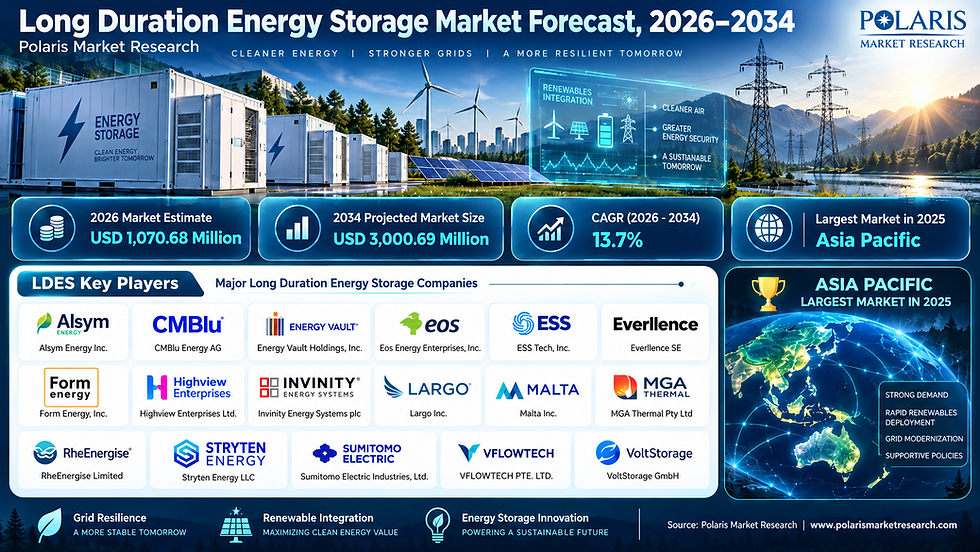
The global power sector is undergoing a massive transformation, driven by accelerating decarbonization mandates, rapid renewable energy integration, and escalating electricity demands from emerging technologies. At the heart of this transition lies the long duration energy storage market, which was valued at USD 943.38 million in 2025 and is projected to expand significantly, reaching USD 3,000.69 million by 2034 while exhibiting a remarkable CAGR of 13.7% from 2026 to 2034.
As grids worldwide transition away from conventional fossil-fuel generation, advanced energy storage technologies are becoming indispensable. This comprehensive analysis explores the market overview, key growth drivers, technological dynamics, challenges, competitive landscape, and future outlook of the sector.
Market Overview and Economic Context
Long duration energy storage systems are engineered to deliver stored electricity for extended periods, ranging from multiple hours to several days. Unlike conventional short-duration lithium-ion batteries that are optimized for rapid peak shaving, these advanced systems including pumped hydro, flow batteries, iron-air batteries, compressed air energy storage, and chemical hydrogen solutions provide multi-day balancing essential for variable wind and solar generation.
Geographic and regional adoption patterns show distinct leadership. In 2025, Asia Pacific emerged as the largest market, while North America held the largest share of 35.72% in the global market owing to intense capacity additions and grid development activities. Furthermore, the Asia Pacific market is estimated to expand at a 16.32% CAGR during the forecast period, powered by aggressive green energy investments and grid resiliency initiatives.
🌐𝐁𝐫𝐨𝐰𝐬𝐞 𝐅𝐮𝐥𝐥 𝐈𝐧𝐬𝐢𝐠𝐡𝐭𝐬:
Key Market Growth Drivers
The rapid expansion of the energy storage systems industry is propelled by several foundational catalysts:
Rising Technological Advancements in Energy Storage Solutions: Innovations in next-generation batteries, thermal storage, and hydrogen systems offer superior performance, enhanced safety, and extended lifespans compared to traditional options.
Increasing Urbanization Worldwide: With 58% of the global population residing in urban areas in 2025, modern cities demand sustainable power sources, smart infrastructure, and robust electrification of public transit.
Rising Electricity Demand from AI and Data Centers: The exponential expansion of artificial intelligence infrastructure and data centers places immense strain on power networks, driving an urgent need for reliable backup power, load shifting, and grid disruption protection.
Decarbonization Drives and Government Mandates: Global climate commitments and favorable public policies, such as the U.S. Department of Energy’s LDES demonstration programs and tax incentives, are actively accelerating clean energy adoption.
Key Market Dynamics
The evolution of the sector is shaped by complex operational and digital dynamics:
Smart Grid Integration: Advanced energy management systems and digital twins enable operators to simulate virtual asset versions, assess degradation, and optimize charging schedules dynamically.
AI-Powered Predictive Maintenance: Artificial intelligence algorithms forecast renewable generation fluctuations and electricity demand, optimizing battery performance while minimizing unnecessary cycling and degradation.
Revenue Diversification: Projects increasingly leverage multiple income streams including energy arbitrage, capacity payments, and ancillary grid-balancing services to enhance project bankability and mitigate market volatility.
Market Challenges and Opportunities
Navigating the future of clean energy infrastructure involves balancing notable hurdles with lucrative expansion opportunities:
High Initial Project Costs (Challenge): Substantial capital expenditures are required for site development, heavy equipment manufacturing, and grid connection, compounded by less mature supply chains for emerging storage technologies.
Revenue Uncertainty (Challenge): Variability in power prices, regulatory frameworks, and market mechanisms across different electricity regions can complicate long-term financing decisions for developers.
Growth in Data Center and AI Infrastructure (Opportunity): With data centers consuming approximately 2% of global electricity consumption and global data center capacity growing rapidly, LDES providers have a prime opportunity to supply reliable, low-carbon power solutions to energy-intensive sites.
🌐𝐁𝐫𝐨𝐰𝐬𝐞 𝐅𝐮𝐥𝐥 𝐈𝐧𝐬𝐢𝐠𝐡𝐭𝐬:
Market Segmentation Analysis
The industry exhibits diverse technological, duration, and application-based segmentation:
By Technology: The mechanical storage segment held the largest revenue share of 45.68% in 2025, driven by high scalability and efficiency in bulk storage. Meanwhile, the electrochemical storage segment accounted for 22.63%, and the chemical storage segment is projected to grow at a rapid 18.21% CAGR from 2026 to 2034 due to surging interest in power-to-gas and hydrogen technologies.
By Duration: Systems offering 8 to 24 hours dominated with a 69.84% market share in 2025. Conversely, the >36 hours segment is anticipated to record a high CAGR of 17.86% through 2034, driven by the need for multi-day resilience during extreme weather events.
By Capacity: Systems exceeding 100 MW captured a 24.60% share in 2025, while the 50–100 MW segment is projected to grow at a 13.42% CAGR from 2026 to 2034 to support regional power networks and industrial microgrids.
By Application: Renewable energy integration dominated with a 40.16% revenue share in 2025, while the off-grid & microgrid systems segment is projected to register a 14.67% CAGR during the forecast period.
By End User: The utilities sector achieved a 47.18% market share in 2025, while the residential & commercial segment is expected to post a 14.61% CAGR from 2026 to 2034.
Market Key Companies
The market features a dynamic mix of specialized technology developers, battery manufacturers, and engineering enterprises driving global innovation. Key industry participants include:
Alsym Energy Inc.
CMBlu Energy AG
Energy Vault Holdings, Inc.
Eos Energy Enterprises, Inc.
ESS Tech, Inc.
Everllence SE
Form Energy, Inc.
Highview Enterprises Ltd.
Invinity Energy Systems plc
Largo Inc.
Malta Inc.
MGA Thermal Pty Ltd
RheEnergise Limited
Stryten Energy LLC
Sumitomo Electric Industries, Ltd.
VFLOWTECH PTE. LTD.
VoltStorage GmbH
Market Trends and Future Outlook
Key technology trends such as the commercial deployment of iron-air batteries for multi-day storage, scalable flow-battery architectures, cryogenic liquid-air energy storage, and advanced thermal storage solutions are continuously redefining industry standards.
With the global push toward net-zero emissions, supportive regulatory frameworks like the UK’s cap-and-floor scheme, and massive grid modernization commitments (such as J.P. Morgan’s projection of USD 5.8 trillion in global grid investment from 2026–2035), the long duration energy storage market is well-positioned for transformative expansion over the next decade. As costs decline and technological maturity increases, LDES will remain a cornerstone of a resilient, secure, and fully decarbonized global energy future.

Comments