The Global Asset Tokenization Market: Reaching USD 45.40 Trillion by 2034 with a 42.7% CAGR 🚀📈
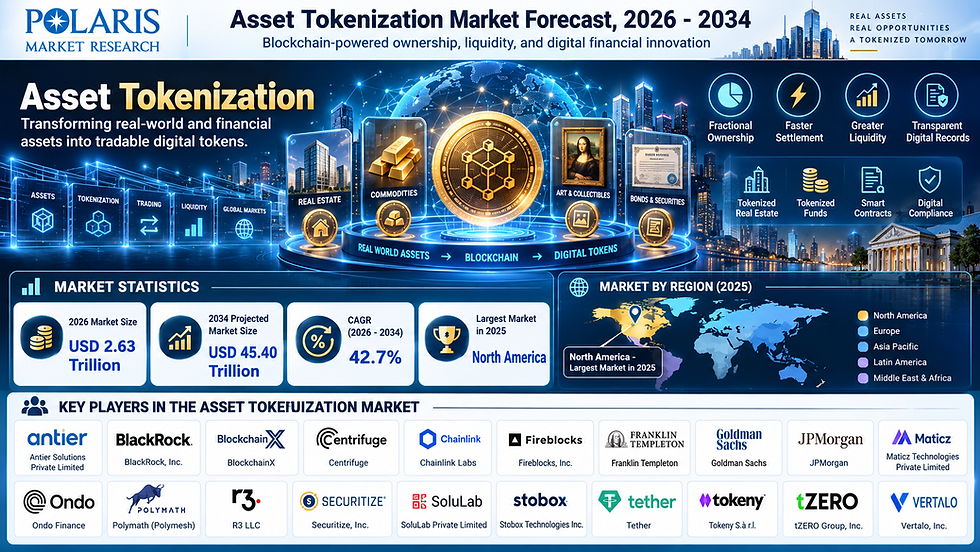
The global asset tokenization market is experiencing an unprecedented transformation, acting as a crucial bridge between traditional finance (TradFi) and decentralized finance (DeFi). According to recent industry reports, the asset tokenization market size was valued at USD 1.85 trillion in 2025 and is projected to skyrocket to USD 45.40 trillion by 2034, exhibiting a remarkable Compound Annual Growth Rate (CAGR) of 42.7% during the forecast period of 2026–2034.
Market Overview 🌐
Asset tokenization is the process of converting real-world assets such as real estate, artwork, stocks, commodities, and intellectual property into digital tokens that reside on a blockchain or distributed ledger technology (DLT) network. Unlike native cryptocurrencies, tokenization connects an existing physical or financial asset claim directly with a secure digital token.
Geographically, North America dominated the market with a 38.62% share in 2025, driven by mature financial ecosystems, advanced blockchain deployments, and heavy institutional investments. Meanwhile, the Asia Pacific market is poised for rapid expansion, registering an impressive 48.78% CAGR through 2034, fueled by dynamic fintech developments and digital asset initiatives across countries like Singapore, Hong Kong, India, and Japan.
🌐𝐁𝐫𝐨𝐰𝐬𝐞 𝐅𝐮𝐥𝐥 𝐈𝐧𝐬𝐢𝐠𝐡𝐭𝐬:
Key Market Growth Drivers 🚀
Increasing Adoption of Smartphones: Widespread smartphone usage with advanced biometric security, encryption, and integrated digital wallets provides users with secure, seamless access to buy, sell, and manage tokenized assets.
Rising Advancement in Layer 2 Scaling Solutions and Smart Contracts: Technological enhancements in scalability, lower transaction costs, faster processing, and 5G infrastructure integration accelerate the convergence of TradFi and DeFi.
Increasing Regulatory Clarity for Digital Assets: Evolving legal frameworks such as the U.S. Digital Asset Market CLARITY Act and the EU’s MiCA regulations remove compliance ambiguities, encouraging greater institutional participation.
Growth of Real-World Asset (RWA) Tokenization: Financial institutions are increasingly adopting blockchain infrastructure for tokenized real estate, government securities, money market funds, and private credit to program transactions and improve transparency.
Convergence of DeFi and Traditional Finance: Interoperability between public and permissioned networks enables regulated assets to participate in programmable financial workflows, optimizing collateral management and lending.
Growing Demand for Fractional Ownership: Digital tokens divide high-value, illiquid alternative assets (like real estate and fine art) into smaller units, reducing minimum investment thresholds and expanding investor access.
Advancements in Blockchain and Tokenization Infrastructure: Modern platforms integrate automated compliance, smart contract rules, advanced custody solutions, and cross-chain interoperability to support institutional-grade issuance.
Key Dynamics ⚖️
The rapid evolution of the tokenization landscape is shaped by balancing monumental growth drivers against structural and regulatory hurdles:
Regulatory Fragmentation: Varying cross-border legal frameworks, asset classifications, and compliance requirements increase operational costs for multi-jurisdictional firms.
Smart Contract and Cybersecurity Risks: Potential vulnerabilities, private key compromises, and programming errors demand institutional-grade custody, rigorous code audits, and robust transaction monitoring.
Custodial Liability and Ownership Complexity: Multi-party arrangements involving issuers, custodians, and transfer agents require strict legal clarity to protect investor ownership rights.
Integration With Legacy Systems: Upgrading traditional trading, clearing, and accounting systems to support 24/7 blockchain settlement requires significant technological investment and parallel layer implementation.
Market Challenges and Opportunities 💡
Challenges
Limited interoperability across disparate blockchain networks can fragment secondary-market liquidity.
Complex legal links between digital tokens and underlying physical collateral require continuous risk mitigation.
Opportunities
AI-Enabled Asset Valuation and Risk Analytics: Integrating artificial intelligence enables automated asset valuation, real-time risk assessments, continuous compliance monitoring, and fraud detection.
Zero-Knowledge and Privacy-Enhancing Tokenization: Utilizing zero-knowledge proofs allows institutions to verify investor eligibility and conduct secure transactions while maintaining strict confidentiality and data protection.
🌐𝐁𝐫𝐨𝐰𝐬𝐞 𝐅𝐮𝐥𝐥 𝐈𝐧𝐬𝐢𝐠𝐡𝐭𝐬:
Market Segmentation 📊
The global asset tokenization market is segmented comprehensively across asset types, technologies, and end users:
By Asset Type: Includes Real Estate, Art and Collectibles, Commodities, Intellectual Property, Financial Instruments, Luxury Goods, and Others. Financial Instruments dominated in 2025 with a 34.08% market share, driven by tokenized equities, bonds, and treasury funds. Meanwhile, Intellectual Property is projected to achieve the highest growth at a 49.11% CAGR.
By Technology: Includes Permissioned Blockchain Networks, Permissionless Blockchain Networks, Hybrid Blockchain Models, Smart Contract Platforms, Tokenization Protocols, and Custody Solutions. Permissioned Blockchain Networks led with a 31.84% share in 2025 due to strict access control and regulatory compliance, while Hybrid Blockchain Models are expected to expand at the fastest CAGR of 51.18%.
By End User: Includes Institutional Investors, Retail Investors, Asset Managers, Fundraisers and Issuers, and Others. Institutional Investors captured the largest share at 41.86% in 2025, whereas Retail Investors represent the fastest-growing segment with a 50.31% CAGR.
Market Key Companies 🏢
Major financial powerhouses, infrastructure providers, and specialized technology platforms are spearheading innovation within the industry:
Antier Solutions Private Limited
BlackRock, Inc.
BlockchainX
Centrifuge
Chainlink Labs
Fireblocks, Inc.
Franklin Templeton
Goldman Sachs
JPMorgan
Ondo Finance
Securitize, Inc.
Tether
tZERO Group, Inc.
Market Trends 📈
Institutional Scale-Up: Major institutional players are actively moving past preliminary pilots. For instance, BlackRock’s tokenized fund BUIDL and J.P. Morgan's Kinexys platform are scaling up tokenized treasury assets and cash market funds.
Standardization & Messaging: Integration with ISO 20022 messaging standards is improving interoperability between tokenization platforms and legacy banking architecture.
DeFi and RWA Cross-Over: Tokenized products are increasingly utilized for automated lending, collateral management, and on-chain liquidity pools.
Future Outlook 🔮
Looking toward 2034, the asset tokenization market is firmly transitioning from isolated proofs-of-concept into live, production-scale financial market infrastructure. With the market expected to surge to USD 45.40 trillion at a robust CAGR of 42.7%, future growth will rely heavily on advanced cross-chain interoperability, comprehensive regulatory harmonization, AI-driven risk mitigation, and seamless integration across global financial systems.

Comments