Unlocking Enterprise Security: DevSecOps Orchestration Market Projected to Reach USD 7.56 Billion by 2034 at a 23.49% CAGR 🚀
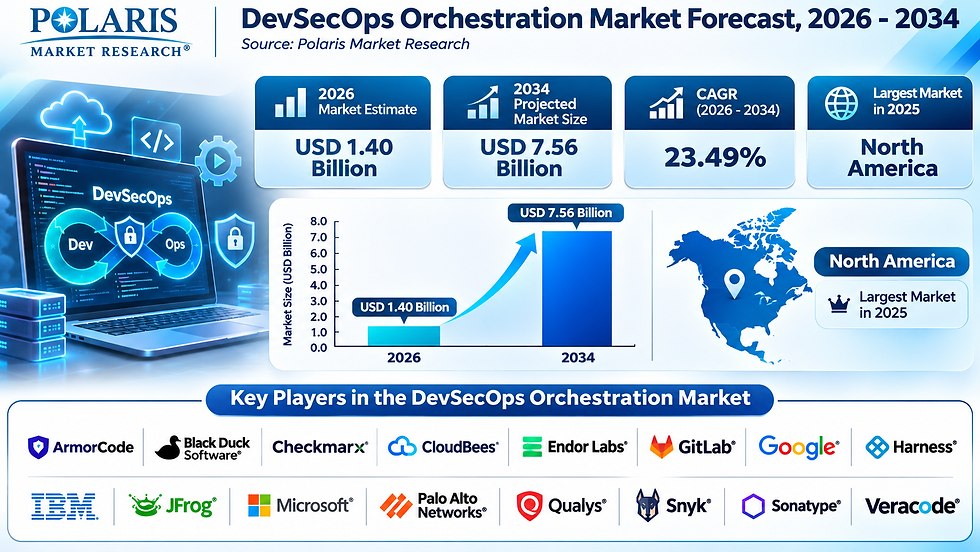
The global DevSecOps orchestration market is experiencing unprecedented transformation as modern software delivery demands rigorous security without sacrificing development velocity. According to recent industry analysis, the DevSecOps orchestration market size was valued at USD 1.13 billion in 2025 and is projected to reach USD 7.56 billion by 2034, expanding at a robust CAGR of 23.49% from 2026 to 2034. Furthermore, the 2026 market estimate stands at USD 1.40 billion. This remarkable expansion is primarily fueled by surging volumes of AI-generated code, stringent regulatory reporting duties under frameworks like the EU Cyber Resilience Act, and an accelerating enterprise demand for automated remediation.
The DevSecOps orchestration market consists of advanced software and services designed to coordinate security tools, findings, and policies seamlessly across the software delivery pipeline. Unlike traditional security testing tools that merely discover vulnerabilities or general DevOps platforms focused purely on CI/CD speed, orchestration solutions link scanners to build systems, schedule tests, correlate findings, prioritize vulnerabilities, enforce policies, and trigger automated remediation. As organizations navigate increasingly complex threat landscapes, deploying centralized security orchestration layers has become imperative for maintaining robust software supply chain security.
🌐𝐁𝐫𝐨𝐰𝐬𝐞 𝐅𝐮𝐥𝐥 𝐈𝐧𝐬𝐢𝐠𝐡𝐭𝐬:
Key Market Growth Drivers ⚙️
Growth across the DevSecOps orchestration market is underpinned by several critical macro and microeconomic factors that are reshaping enterprise application security strategies:
Rising Security Requirements for AI-Generated Code: The massive expansion of software development output driven by AI coding assistants has created an urgent need to identify vulnerabilities and enforce strict security policies across delivery pipelines. Industry analyses reveal that AI coding tool adoption has surged dramatically, with studies indicating that up to 49% of production code is now AI-generated. This rapid code generation accelerates release cycles but introduces complex vulnerabilities, driving enterprises to invest heavily in DevSecOps orchestration platforms that coordinate automated scanning and risk prioritization in real time.
Stricter Software Vulnerability Reporting Requirements: Global regulatory frameworks are tightening compliance mandates, compelling organizations to establish transparent, auditable vulnerability tracking workflows. For instance, the EU Cyber Resilience Act, which initiated active reporting obligations on September 11, 2026, requires organizations to provide early warnings within 24 hours, full notifications within 72 hours, and comprehensive final reports within 14 days after a fix is available. These strict regulatory timelines cannot be met manually, making automated vulnerability management and policy tracking through orchestration indispensable.
Key Dynamics 🔄
The competitive and operational landscape of the DevSecOps orchestration market is defined by several dynamic shifts in buyer behavior and vendor capabilities:
Shift from Detection to Coordinated Remediation: Commercial priorities are actively moving away from mere vulnerability detection toward coordinated, automated remediation. Vendors are rapidly introducing agentic security functions, hybrid scanning engines, and automated fix generation to reduce manual workloads for development teams.
Platform Bundling vs. Standalone Solutions: Major security and cloud vendors are actively embedding orchestration capabilities into broader application security and delivery platforms. This bundling trend influences enterprise purchasing decisions, often favoring unified platforms over standalone tooling unless specialized coordination is required.
Centralized Control Across Fragmented Toolchains: Enterprises typically deploy a diverse array of security scanners, code repositories, and build systems. The market is witnessing strong demand for independent overlay platforms and centralized control planes that unify these disparate tools without requiring complete infrastructure overhauls.
Market Challenges and Opportunities 💡
Like any fast-evolving technology sector, the DevSecOps orchestration market presents distinct operational hurdles alongside high-value commercial opportunities:
Market Challenges:
Platform Bundling and Unproven Effectiveness: Enterprises frequently hesitate to purchase standalone orchestration tools when major vendors bundle similar features, and buyers demand concrete performance evidence regarding the correctness of automated fixes to avoid production risks.
Integration Complexity: Connecting multi-vendor repositories, legacy scanners, and diverse build systems requires meticulous configuration, access management, and policy alignment.
Operational Risk in Automation: Automated and agentic remediation carries inherent risks of unintended code modifications, necessitating rigorous validation controls and approval workflows.
Market Opportunities:
Growing Demand for Automated and Agentic Remediation: Coupling vulnerability detection directly with fix generation, validation, and deployment workflows presents immense potential to eliminate repetitive manual tasks and accelerate secure software delivery.
Centralized Coordination Across Security Tools: Organizations with complex, multi-vendor security architectures represent a prime growth avenue for platforms capable of standardizing security rules, correlating duplicate alerts, and enforcing quality gates enterprise-wide.
Market Segmentation Analysis 📊
A granular evaluation of the DevSecOps orchestration market highlights distinct segments driving adoption across industries and deployment models:
By Offering: The Software and Platforms segment captured a dominant market share of 62.38% in 2025, driven by enterprise demand for coordinated scanning and pipeline automation. Meanwhile, Services are projected to register the fastest growth at a CAGR of 24.52% from 2026 to 2034, as organizations seek expert consulting and integration support.
By Orchestration Capability: Tool Integration and Coordination led the market in 2025 with 29.34% of the share. However, Automated and Agentic Remediation is anticipated to record the highest growth at a remarkable CAGR of 29.74%, closely followed by Finding Correlation and Prioritization at 24.86% CAGR, Policy and Quality Gate Enforcement (19.46% share in 2025), and Test Scheduling and Execution (23.68% CAGR).
By Control Point: Pipeline Native Platforms captured the largest market share at 43.28% in 2025, embedding security controls directly into source code management and build workflows. Independent Overlay Platforms are expanding at the highest CAGR of 25.37%, while Security Suite Platforms are projected to grow at a 23.82% CAGR.
By Deployment: Cloud deployment represents the leading segment, accounting for 52.76% of the market in 2025 due to its scalability and ease of cross-team collaboration. Hybrid deployment accounted for 27.62% of the market, while on-premises deployment is set to grow at a steady CAGR of 19.84%.
By End User: IT & Telecom stands as the largest end-user segment with 25.84% market share in 2025, followed by BFSI at 23.76%, Government & Public Sector at 13.42%, Healthcare and Life Sciences (projected to grow at 25.73% CAGR), Manufacturing (growing at 22.64% CAGR and holding 10.76% share in 2025), and Retail and Ecommerce (projected at 24.96% CAGR).
By Region: North America leads globally, capturing 38.42% of the market share in 2025, supported by mature vendor ecosystems and federal software assurance guidelines. Europe is registering significant growth at a 23.17% CAGR, heavily driven by EU Cyber Resilience Act mandates. Asia Pacific accounted for 24.78% share in 2025, fueled by massive digital transformation and mobile technology expansion. Latin America and the Middle East & Africa accounted for 6.14% and 5.02% shares respectively.
Market Trends 📈
Current trends within the DevSecOps orchestration market emphasize deep automation and artificial intelligence integration:
AI-Powered Hybrid Scanning: Vendors are increasingly combining deterministic rule-based scanning engines with advanced AI models to accurately assess massive volumes of code and minimize false positives.
Agentic Remediation Workflows: The introduction of zero-touch remediation tools and agentic autofix capabilities allows platforms to propose, validate, and merge vulnerability fixes autonomously.
Policy as Code Enforcement: Organizations are widely adopting policy-as-code frameworks to enforce uniform security checks and automated quality gates that halt non-compliant builds prior to production release.
🌐𝐁𝐫𝐨𝐰𝐬𝐞 𝐅𝐮𝐥𝐥 𝐈𝐧𝐬𝐢𝐠𝐡𝐭𝐬:
Market Key Companies 🏢
The competitive landscape features a rich mix of pipeline-native platforms, security suites, and independent overlay providers. Prominent industry participants shaping the DevSecOps orchestration market include:
ArmorCode
Black Duck Software
Checkmarx
CloudBees
Endor Labs
GitLab
Google
Harness
IBM
JFrog
Microsoft
Palo Alto Networks
Qualys
Snyk
Sonatype
Veracode
Future Outlook 🔮
As the DevSecOps orchestration market marches toward its projected valuation of USD 7.56 billion by 2034, the future of application security will rely heavily on autonomous intelligence and centralized control planes. Automated remediation is fundamentally transforming security operations by bridging the critical gap between vulnerability detection and patch deployment. Furthermore, as software supply chain risks escalate and regulatory scrutiny intensifies worldwide, enterprises that implement sophisticated DevSecOps orchestration strategies will successfully balance rapid software innovation with uncompromised security resilience.


Comments