Third-Party Risk Management Market Is Growing as Businesses Focus on Security and Trust
In today’s connected business world, companies rarely work alone. They depend on external vendors, suppliers, technology providers, cloud platforms, and service partners to keep their operations running smoothly. While these partnerships help businesses grow and become more efficient, they also bring new risks. A security issue at a vendor’s end can quickly become a serious problem for the company that depends on it.
This is why third-party risk management (TPRM) is becoming an important part of modern business strategies. Companies are paying more attention to who they work with, how their partners handle sensitive information, and whether they follow the required security and compliance standards.
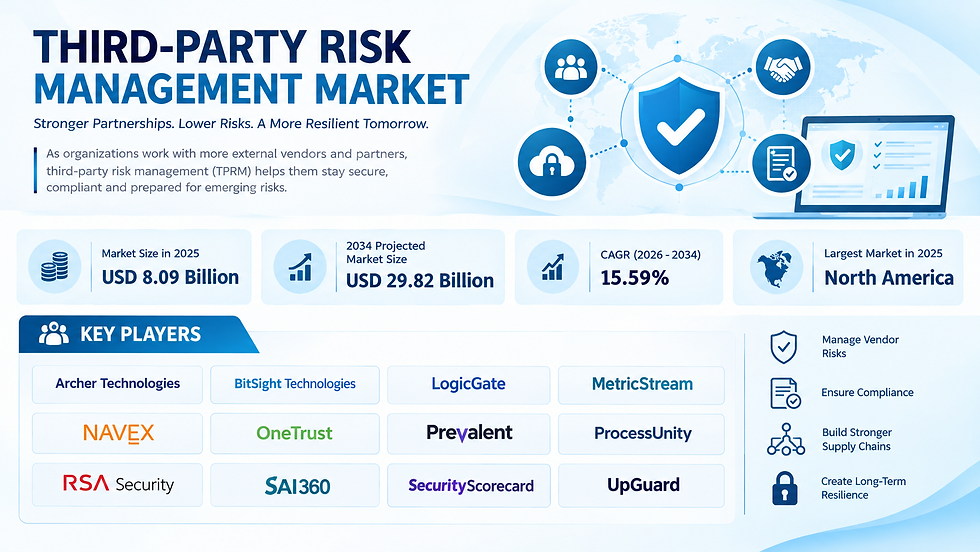
According to Polaris Market Research, the global third-party risk management market was valued at USD 8.09 billion in 2025. The market is projected to reach USD 29.82 billion by 2034, growing at a compound annual growth rate (CAGR) of 15.59% from 2026 to 2034. These figures highlight the growing importance of managing risks across business partnerships.
Why Third-Party Risk Management Matters More Than Ever
Businesses today share large amounts of information with external partners. From customer records and financial data to internal systems and business operations, third parties often have access to valuable company resources.
This creates opportunities for cybercriminals. If a supplier or service provider has weak security measures, attackers may use that weakness to access a larger organization’s network. Such incidents can lead to data breaches, financial losses, legal problems, and damage to a company's reputation.
Third-party risk management helps businesses identify these risks before they become major issues. It involves checking vendors before entering into agreements, reviewing their security practices, monitoring their performance, and taking action when potential problems arise.
Instead of reacting after something goes wrong, companies can use TPRM practices to prepare for risks and make better decisions.
Cybersecurity and Compliance Are Driving Market Growth
One of the biggest factors supporting the growth of the third-party risk management market is the rising number of cyber threats. As businesses adopt cloud technologies and digital services, their dependence on outside providers continues to increase.
A single vendor may work with hundreds of customers, which means a security weakness can affect multiple organizations. Companies are therefore looking for better ways to monitor their vendor networks and identify potential threats early.
Regulatory compliance is another important growth driver. Organizations in industries such as banking, healthcare, and information technology must follow strict rules for protecting sensitive information. They also need to understand whether their external partners meet relevant requirements.
Managing these responsibilities manually can be difficult, particularly for companies that work with a large number of vendors. TPRM platforms help organize vendor information, simplify assessments, maintain records, and support compliance reporting.
Browse In-depth Market Research Report:
Technology Is Making Risk Management Smarter
Technology is changing how businesses approach third-party risk. Traditional methods often depend on spreadsheets, lengthy questionnaires, and periodic assessments. Although these methods can provide useful information, they may not offer a complete picture of changing risks.
Modern TPRM platforms use automation, data analytics, and artificial intelligence to make the process more efficient. These tools can help organizations evaluate vendor information, identify unusual activity, prioritize high-risk relationships, and monitor potential threats.
Cloud-based platforms are also gaining attention because they allow teams to access information from different locations and manage vendor risks through a centralized system.
According to Polaris Market Research, cloud-based platforms accounted for 47% of the market in 2025. This reflects the growing interest in flexible solutions that support real-time monitoring and easier access to risk information.
However, technology alone cannot eliminate every risk. Businesses still need clear policies, trained employees, regular reviews, and strong communication with their partners.
Challenges and Future Opportunities
Despite its benefits, implementing a third-party risk management program can be challenging. The cost of software, system integration, employee training, and ongoing monitoring may create difficulties for smaller organizations.
Another challenge is the amount of information involved. Companies may work with hundreds or thousands of vendors, each with different risk profiles and compliance requirements. Keeping this information accurate and up to date requires consistent effort.
These challenges also create opportunities for technology providers. Solutions that simplify assessments, automate repetitive tasks, and provide clear risk insights can help businesses manage their vendor relationships more effectively.
Looking ahead, AI-powered analytics, continuous monitoring, and predictive risk assessment are likely to play a growing role in the market. Businesses may increasingly focus on identifying warning signs early rather than relying only on periodic vendor reviews.
Conclusion
Third-party risk management is no longer just a compliance task. It is becoming a practical business priority as organizations depend more heavily on external partners and digital services.
By improving vendor assessments, strengthening cybersecurity, and using smarter monitoring tools, companies can build safer and more reliable business relationships.
The projected growth of the third-party risk management market reflects this shift. As security threats and regulatory expectations continue to evolve, businesses that take a proactive approach to third-party risks will be better prepared to protect their data, maintain trust, and support long-term growth.
More Trending Latest Reports By Polaris Market Research:


Comments